Why Is It the Big Bad Wolf and Never the Bad Big Wolf? English's Unwritten Ear Rules
No English-speaking child is ever taught adjective order, yet none of them says 'a green old French car'. Why tick-tock is never tock-tick, why ping-pong is never pong-ping: same secret. From Mark Forsyth's famous example to the subjectivity research of Scontras, Degen and Goodman, from Cooper and Ross's 'me first' principle to ablaut reduplication, we explore English's unwritten ear rules, why they confuse Turkish speakers, and one practical rule of thumb that actually works.
Listen to Article (High-Definition Audio)
The Thing Nobody Teaches in "Big Bad Wolf" Class
Tell the story of the Three Little Pigs to an English-speaking child and you cannot get the wolf's name wrong: the Big Bad Wolf. Now try: "the Bad Big Wolf." Did your ear catch something? Odd, a bit childish, like the sentence tipped over on its side.
The strange part is that no one ever taught that child an adjective-order rule. No lesson, no formula on a blackboard. Yet by age five they say "a little old lady" and never "an old little lady". It is one small corner of a catalogue of rules that live inside a language, rules nobody wrote down and everybody obeys.
In this piece we will peek into that hidden catalogue. You will get the practical rule you need as a learner, plus some fascinating science on why it works the way it does.
The Eight-Step Staircase
Textbooks usually list the order like this. The writer Mark Forsyth, in The Elements of Eloquence, shows it off with delight and stresses what a deep instinct it is:
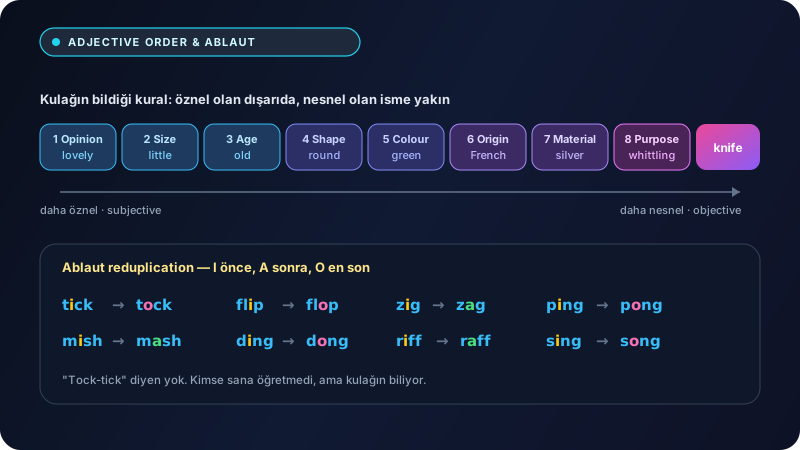
Opinion → Size → Age → Shape → Colour → Origin → Material → Purpose → NOUN
a lovely little old round green French silver whittling knife
Nobody says that sentence in real life, of course. But you can feel what happens when you break the order: "a French silver round lovely green old whittling little knife" makes your brain stumble. Every word is right, every bit of grammar is right. The order is simply off the path your ear has worn.
So Why This Order? The Subjectivity Research
For years the answer was "because that is how it is". In 2017, Gregory Scontras, Judith Degen and Noah Goodman published a study in Open Mind with an elegant explanation: the more subjective an adjective is, the further it sits from the noun.
The logic is simple. When you say "lovely", that is your opinion; someone else could find the same knife ugly. "Silver" is more measurable, a more objective property. Language keeps the objective property close to the noun, because it belongs more to the noun's identity. Subjective judgments drift outward to the edge of the phrase.
Which tells you something useful: you do not need to memorize eight steps. Just ask yourself: "Is this adjective one person's opinion, or something everyone would agree on?" Opinion goes outside, fact goes inside.
The one rule to keep in your pocket
Opinion first, material and purpose hugging the noun. "A gorgeous old wooden table." Size, age and colour tend to settle in the middle by themselves. Stop at three adjectives; any more tires the ear and starts to sound staged.
Why Is This Hard for Turkish Speakers?
Turkish adjective order is much freer. "Küçük güzel bir ev" and "güzel küçük bir ev" are both comfortable; the difference is tiny. That flexibility in your first language leaves you without an instinct in English: which one is right, and how would you know?
The good news: Turkish has a hidden tendency too. Notice that you say "küçük kırmızı araba" far more often than "kırmızı küçük araba". Size comes before colour, just as in English. Turkish simply does not enforce it. English does. So you already have a kind of instinct; your task is to switch it from optional to mandatory.
The Comma Question: When Do Two Adjectives Need One?
When writing, the second question is: do I put a comma between adjectives? Two easy tests:
- The "and" test: Can you put "and" between them? If "a smart and funny colleague" sounds natural, use a comma: a smart, funny colleague.
- The swap test: Can you reverse them? If "a funny, smart colleague" is also natural, comma. But if "a red big apple" sounds wrong, no comma: a big red apple.
In short: adjectives whose order is free get commas, adjectives whose order is fixed do not.
Same Ear, Different Game: Ablaut Reduplication
Now the fun part. This same family of hidden rules does not only live in adjectives. Tick-tock, ping-pong, flip-flop, zig-zag, criss-cross, mish-mash, riff-raff, ding-dong, hip-hop, sing-song, chit-chat, dilly-dally, shilly-shally.
You will notice the same thing in all of them: the first vowel is always the higher, more forward sound (i), and the second is lower and further back (a or o). The sequence is always:
I → A → O
tick-tock · flip-flop · zig-zag · ping-pong · mish-mash · riff-raff · ding-dong
Nobody says "tock-tick". You have never heard "pong-ping" or "zag-zig". Linguists call it ablaut reduplication, and Forsyth describes it as a rule nobody warned you about but every speaker knows. The vowel order tracks the tongue's position in the mouth: it starts forward (i) and moves backward (a, then o).
There is a payoff: when you make up or hear a new word pair, you can check whether it feels natural. "Sniff-snuff" is natural. "Snuff-sniff" is not.
"Me First": The Quiet Law of Pairs
The same logic applies to binomials, those fixed pairs: salt and pepper, ladies and gentlemen, black and white, bread and butter, back and forth. These orders are not random either. William Cooper and John Ross's 1975 paper "World Order" explains some of the tendencies through a "Me First" principle: the speaker tends to name what is near to them, or matters to them, first. Hence here and there, now and then, this and that. Another tendency: the shorter word goes first (law and order).
None of these is absolute; they are leanings. But when the order is flipped, the phrase sounds foreign and loses its flavor.
How to Use This in Real Life
- When writing: Cap adjective chains at three and apply "opinion first, material and purpose near the noun".
- When speaking: If a long string is coming, stop and tidy it. English speakers do not love long chains either; "a nice old house" is perfectly fine.
- When listening: Treat a phrase that sounds "off" as a clue. The ear knows the rule without knowing it.
- When reading: Watch for places in poems and lyrics where these rules are broken on purpose. Writers bend the order precisely to create an effect.
You think you learn a language through rules, but most rules are just the written-down version of something your ear has known for a long time. So next time you say "the big bad wolf", give a small wink to the quiet intelligence behind that order. Nobody taught you, and you already knew.
Download Vocabulary Guide For This Article
Download our custom-made printable PDF study sheet featuring all the essential vocabulary related to this topic.

Hakan Dağ
Founder & Language Architect
Software Engineer and English Instructor with 15+ years of experience in IT and education technology. Passionate about merging smart tools with genuine pedagogy.
Related Posts
Where Turkish -miş Disappears in English: The Moment You State as Fact Something You Only Heard
In a Monday standup someone said, 'The investor pulled out.' The room went quiet. They had only seen a Slack rumor. In Turkish the same sentence would have been 'Yatırımcı çekilmiş', and everyone would have heard that the source was indirect. English has no such ending. With Wallace Chafe's 1986 distinction, Aksu-Koç and Slobin's 'unprepared mind', and four doors you can actually use in a meeting: I saw it, I infer it, I heard it, I just found out.
The Subjunctive Mood and the Realm of Irrealis: Demystifying English's Most Covert Grammatical Modality
Why is the common textbook claim that 'the subjunctive is dead in modern English' fundamentally flawed? From high-stakes institutional contracts to diplomatic communiqués, the Mandative Subjunctive, counterfactual 'were' irrealis, and formulaic relics like 'Be that as it may' define executive-level syntactic mastery. We examine how English covertly strips inflection where Turkish deploys overt mood morphemes, providing a comprehensive operational framework for bilingual professionals.
The Inversion Architecture in Advanced English: Rhetorical Gravitas, Syntactic Tension, and the Mechanics of Negative Fronting
Why does saying 'We have rarely seen this' register as routine observation, whereas 'Rarely have we seen this' instantly commands focused silence across an auditorium? We unpack the cognitive mechanics of Subject-Auxiliary Inversion (SAI), dissect how negative adverbial fronting creates irresistible psychological anticipation, and analyze five strategic syntactic patterns that establish non-negotiable executive authority.
💬 Discussion0
You must log in to comment.
Put Learning into Practice!
Improve your vocabulary with WordMaster, practice with an AI tutor.
Start for Free