The Inversion Architecture in Advanced English: Rhetorical Gravitas, Syntactic Tension, and the Mechanics of Negative Fronting
Why does saying 'We have rarely seen this' register as routine observation, whereas 'Rarely have we seen this' instantly commands focused silence across an auditorium? We unpack the cognitive mechanics of Subject-Auxiliary Inversion (SAI), dissect how negative adverbial fronting creates irresistible psychological anticipation, and analyze five strategic syntactic patterns that establish non-negotiable executive authority.
Listen to Article (High-Definition Audio)
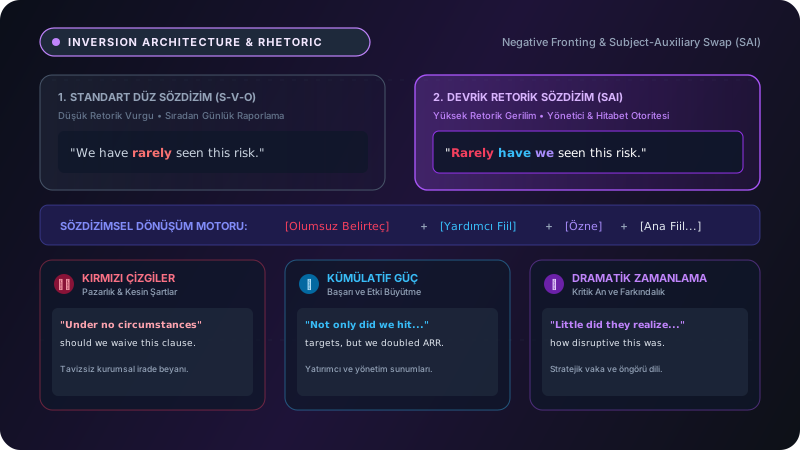
The Chemistry of Gravitas: What Transforms an Everyday Statement into a Command of the Floor?
Imagine sitting in a high-stakes executive auditorium listening to two different managing partners deliver a briefing on commodity portfolio volatility:
Speaker A (Flat / Neutral SVO Order):
"We have seldom encountered such volatility in our commodity portfolio, and we should not underestimate this challenge under any circumstances."
Speaker B (Inverted / Rhetorically Primed Order):
"Seldom have we encountered such volatility in our commodity portfolio, and under no circumstances should we underestimate this challenge."
Listening to Speaker A, your intellect registers the facts, yet your nervous system remains dormant; it is another routine corporate slide deck. The moment Speaker B initiates the cadence with "Seldom have we...", however, every distracted glance in the room snaps toward the podium. Interlocutors sit upright because human auditory cognition intuitively recognizes that an insight of supreme strategic consequence is about to land.
This psychological phenomenon is driven by Subject-Auxiliary Inversion (SAI). While grammar textbooks often reduce this pattern to mechanical test drills, it is in reality one of the most devastating instruments of rhetorical authority in the English language—deployed with surgical intent by jurists, statesmen, and visionary founders alike.
The Cognitive Mechanics: Why Inversion Awakens the Human Brain
English is an exceptionally disciplined SVO (Subject - Verb - Object) tongue. The human auditory cortex anticipates parsing the agent (who?), followed immediately by the predicate (did what?):
[Subject: The board] + [Auxiliary: had] + [Adverb: scarcely] + [Main Verb: approved] the acquisition...
When an orator extracts a restrictive or negative adverbial element (scarcely, rarely, under no circumstances) and fronts it to the clause boundary (a syntactic operation termed Negative Fronting), the listener's structural expectations are deliberately upended:
"When the brain encounters a negative boundary marker at the very gate of an utterance, cognitive alarms fire: 'Disregard routine parsing; a non-negotiable exception or foundational claim is materializing.' Subject-auxiliary inversion is the syntactic seal that confirms this heightened state of attention."
The L1 Transfer Trap: Avoid Direct Literal Scrambling
A persistent pitfall for speakers from flexible word-order languages (such as Turkish or German) is assuming that one can simply invert the subject and lexical verb directly. Because English preserves strict rigid syntax, you cannot move the main semantic verb ahead of the subject:
- Syntactic Disruption: "Rarely saw we such an outcome." (Blatantly ungrammatical.)
- Accurate Inversion Engine: "Rarely did we see such an outcome."
Inversion borrows the structural framework of an interrogative question. If a modal or auxiliary already exists in the verb phrase (have, should, can, will), it migrates to the pre-subject position. If the clause contains only a lexical verb, a dummy operator (do / does / did) must be requisitioned.
Five Strategic Inversion Blueprints for Leadership Discourse
| Fronted Trigger | Pragmatic Purpose | Executive Exemplar |
|---|---|---|
| Under no circumstances | Drawing an unbendable red line; establishing zero tolerance in negotiation. | "Under no circumstances will we compromise on data sovereign governance." |
| Not only... but also | Cumulative magnification; elevating an operational win to exponential scale. | "Not only did we halt revenue leakage, but we also expanded net margins by 32%." |
| Only after / Only when | Stipulating an absolute prerequisite before granting commercial authorization. | "Only after third-party penetration testing can we sanction general release." |
| Seldom / Rarely | Framing an unprecedented secular market transition or historical crisis. | "Seldom has an industry experienced such severe structural disruption." |
| Little did [they] suspect | Disclosing a hidden strategic pivot or retrospective asymmetry in case studies. | "Little did incumbent players realize how rapidly open protocols would commoditize them." |
Temporal Climax Patterns: "No Sooner" and "Hardly / Scarcely"
When narrating corporate history or presenting high-velocity market events, deploy these balanced correlatives to illustrate immediate consequence:
NO SOONER ... THAN
"No sooner had the term sheet circulated than competing syndicates raised their bids."
Denotes immediate, instantaneous sequence.
SCARCELY / HARDLY ... WHEN
"Scarcely had the merger finalized when regulatory scrutiny intensified."
Pairs exclusively with 'when' (never 'than').
Calibrating Rhetorical Dosage: Seasoning versus Main Course
Inversion functions precisely like a potent culinary spice. A judicious pinch elevates the entire dish; dumping an entire shaker makes the meal inedible. If you attempt to construct every third sentence in a meeting using "Rarely did we...", "Little did we...", your discourse will sound theatrical, contrived, and pompous.
The master strategy is discipline: construct your baseline exposition in lucid, muscular SVO clarity. Then, when you arrive at your pivotal non-negotiable claim or strategic climax, drop a single, flawlessly formed inverted sentence into the conversation. That solitary sentence will resonate through the room long after the slides are turned off.
Download Vocabulary Guide For This Article
Download our custom-made printable PDF study sheet featuring all the essential vocabulary related to this topic.

Hakan Dağ
Founder & Language Architect
Software Engineer and English Instructor with 15+ years of experience in IT and education technology. Passionate about merging smart tools with genuine pedagogy.
Related Posts
Come or Go? The Hidden Point of View Behind Come, Go, Bring and Take
In Turkish, 'yarın sana geliyorum' feels straightforward. In English, come and go can shift depending on where the speaker, listener, or meeting point sits in the mental map. The same small map controls bring and take. This is a practical way to feel the direction instead of memorising four isolated rules.
Where Turkish -miş Disappears in English: The Moment You State as Fact Something You Only Heard
In a Monday standup someone said, 'The investor pulled out.' The room went quiet. They had only seen a Slack rumor. In Turkish the same sentence would have been 'Yatırımcı çekilmiş', and everyone would have heard that the source was indirect. English has no such ending. With Wallace Chafe's 1986 distinction, Aksu-Koç and Slobin's 'unprepared mind', and four doors you can actually use in a meeting: I saw it, I infer it, I heard it, I just found out.
Why Is It the Big Bad Wolf and Never the Bad Big Wolf? English's Unwritten Ear Rules
No English-speaking child is ever taught adjective order, yet none of them says 'a green old French car'. Why tick-tock is never tock-tick, why ping-pong is never pong-ping: same secret. From Mark Forsyth's famous example to the subjectivity research of Scontras, Degen and Goodman, from Cooper and Ross's 'me first' principle to ablaut reduplication, we explore English's unwritten ear rules, why they confuse Turkish speakers, and one practical rule of thumb that actually works.
💬 Discussion0
You must log in to comment.
Put Learning into Practice!
Improve your vocabulary with WordMaster, practice with an AI tutor.
Start for Free