Where Turkish -miş Disappears in English: The Moment You State as Fact Something You Only Heard
In a Monday standup someone said, 'The investor pulled out.' The room went quiet. They had only seen a Slack rumor. In Turkish the same sentence would have been 'Yatırımcı çekilmiş', and everyone would have heard that the source was indirect. English has no such ending. With Wallace Chafe's 1986 distinction, Aksu-Koç and Slobin's 'unprepared mind', and four doors you can actually use in a meeting: I saw it, I infer it, I heard it, I just found out.
Listen to Article (High-Definition Audio)
The Room Went Quiet
Last winter I sat in on a Monday standup with a product team in Istanbul. Someone new, still half-looking at a laptop, said in a perfectly calm voice: "The investor pulled out."
Nobody sipped their tea. The manager's eyebrow went up. Someone opened a calendar. Ten seconds later the same person, a little flushed, added: "Well, I mean, I saw it on Slack. Someone said maybe."
The damage was small. The meeting went on. But what happened in those ten seconds was not a grammar mistake. The sentence was correct. The pronunciation was clean. What had vanished was a piece of information Turkish hides inside the verb: I did not see this myself.
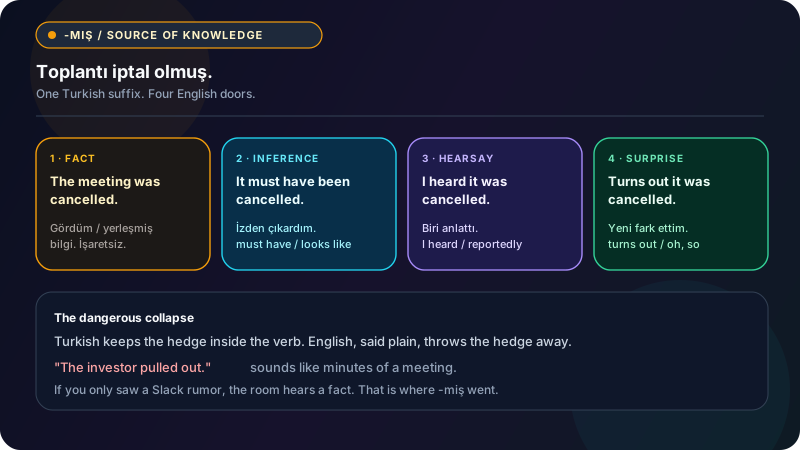
In Turkish the same news would have been "Yatırımcı çekilmiş." Everyone in the room would have heard, from that small -miş, that the source was indirect. Cross into English and the ending evaporates. A plain past tense takes its place. And a plain past tense, in English, says: I am offering this as established.
That evaporation is what this piece is about. Not politeness softening. That is a different problem. This one is sneakier: the gap between what you know and what you heard does not live inside the English verb.
The Textbook Story About -miş, and the Rest of It
Most of us were taught a tidy split. -di means you saw it, -miş means you heard it. Half true. Half-true rules burn more than false ones, because they feel reliable.
You say "Atatürk 1881'de doğdu." You were not there. You still use -di, because for you the fact is settled. In Lars Johanson's terms for Turkic, -di is not a "witnessed" stamp. It is the unmarked past. -miş is the marked one. Johanson calls this marking indirective: a sign that the knowledge came by an indirect path, or that the speaker's mind was not ready for the event.
So -miş is not doing one job. It is doing at least four, and English sends those four jobs out through four different doors. Try to cover all of them with apparently and you start to sound either gossipy or like a person who believes nothing.
One sentence, four doors
Toplantı iptal olmuş.
The speaker may have seen the empty room, inferred it, heard it from someone, or just noticed the calendar and been surprised. Turkish handles all four with one ending. English does not.
The "Unprepared Mind": What Slobin Noticed
Dan Slobin and Ayhan Aksu, first in 1982 and then in the 1986 Chafe and Nichols volume Evidentiality, gave -miş a frame that still holds. The ending does not only say "I heard this." It also says the speaker's mind was unprepared for the event. Linguists call that mirativity: the knowledge is new, unexpected, not yet digested.
You open the curtain and say "Aa, kar yağmış!" You can see the snow. Nobody told you. You still reach for -miş rather than -di, because you did not watch it fall and your mind was not ready. English does not say "Apparently it snowed" here. That sounds like someone reported it to you. The natural line is closer to "Oh. It snowed." or "Turns out it snowed."
Scott DeLancey argued in 1997 that surprise should be kept apart from source-marking. Some languages mark them separately. Turkish loads both onto one ending. That is why no single English word can cover -miş. Believing that one word can is the actual mistake.
English Puts the Job in Words, Not in the Verb
In that same 1986 book, Wallace Chafe looked at how English carries this information in conversation and in academic writing. Source does not live in the inflection. It lives in adverbs, modals, and small verbs. His layers, translated into meeting English, look like this:
- Belief: I think, I guess, I suppose. This marks your opinion, not your source. "In my view."
- Inference: must have, it seems, it looks like. You saw a trace and built the story yourself.
- Hearsay: I heard, someone said, apparently, reportedly. The news came from a mouth.
- Fresh discovery: turns out, oh, I didn't realize. Your voice, plus these small words, does the work the verb refuses to do.
The Turkish speaker's reflex is to patch the missing ending with I think. Understandable. But I think the investor pulled out does not mean "my source is indirect" to an English ear. It means "this is my reading of it." A reading and a rumor are not the same thing. One is a view. The other is news. News dressed up as a view sounds even stranger in a room: people hear you as both certain and unwilling to stand behind it.
Four Doors, Side by Side
Don't read the table as a list to memorize. These are the four questions to ask yourself before a past-tense claim. The question can stay in Turkish. The door has to be English.
| What you actually know | Door | English | Wrong door |
|---|---|---|---|
| I saw it, or this is settled knowledge. | Plain past | The client cancelled the call. | Sticking apparently on everything. Then you sound like you own no news at all. |
| I saw the result, not the event. Lights off, coat gone. | Inference | She must have left. / It looks like she left. | She left. |
| Someone told me. Slack, a corridor, "I heard that." | Hearsay | I heard the client cancelled. / Apparently the client cancelled. | The client cancelled. |
| I just noticed, and it surprised me. | Surprise | Turns out the meeting was cancelled. / Oh — it was cancelled. | Apparently the meeting was cancelled. (sounds reported) |
| I did it and didn't notice. Uyuyakalmışım. | First person | I must have fallen asleep. / I fell asleep and didn't notice. | Apparently I fell asleep. |
| A story, a fairy tale, "bir varmış bir yokmuş." | Narrative | Once upon a time there was an old woman. | There apparently was an old woman. |
The last row looks like a joke. I know. The logic is the same. Sometimes -miş marks a source, sometimes it is a storytelling key, sometimes it only says "this just hit me." English parks those three moods in three different places. Sit all of them on the apparently chair and even a fairy tale starts to sound like gossip.
Why "Apparently I Fell Asleep" Sounds Off
This is the warmest trap, and the one Turkish speakers fall into most. Uyuyakalmışım is a completely ordinary sentence. You slept, you didn't notice, you woke up, you were surprised at yourself. The ending here carries your unpreparedness, not somebody else's testimony.
Apparently I fell asleep is a different film. The listener thinks someone told you. Maybe the person next to you. Maybe a video. That is not what you meant. What you meant was I must have fallen asleep, or the warmer I fell asleep without even noticing.
The same hole is open for cüzdanım düşmüş. You saw it on the floor. Don't say Apparently my wallet fell. Say Oh — my wallet fell, or, if you are inferring, My wallet must have fallen out. A small difference. But the feeling that you are not a witness to your own life adds up if you repeat it.
Apparently, Reportedly, Allegedly: Not Three Ways to Say "I Heard"
Once you are in the hearsay door, the words are not interchangeable. The ear is fussy here.
- I heard / someone said / word is. The honest door. It does not hide that a person was the source. In a meeting, start here. "I heard the launch slipped to Thursday. Can someone confirm?" You pass the news and you pass the ball.
- Apparently. Works for hearsay and for soft inference. In British English there is often a slight eyebrow in it: "I'm passing this on, it isn't quite my word." In American English it can sit flatter, closer to "from what I can tell." Eight times a day and you sound like you believe nothing.
- Reportedly / according to. Colder, more written. Cleaner than I heard in an email or a report. "According to the warehouse note, two cartons arrived damaged."
- Allegedly. It smells like law. Use it in a standup about a colleague's slip and you don't shrink a rumor, you grow an accusation. The distance journalists keep gets heavy in an office corridor. If you mean "I heard," allegedly is not your word.
A small ear test
Read these three out loud. Which one is corridor gossip, which one is minutes, which one is a lawyer?
I heard Maya missed the deadline.
Maya reportedly missed the deadline.
Maya allegedly missed the deadline.
Same event. Three different relationships. Turkish can cover all three with kaçırmış. English can't.
The Ending That Evaporates in Email
In speech, your voice, your eyebrow, the half-sentence you add ("well, I mean") can repair a little. In writing there is no repair. Look at these lines. All of them are grammatically clean. Some hide the source. Some show it.
- You opened the box. "Two cartons arrived damaged. I opened them this morning." No marker needed. You saw it. Say so. People relax.
- Someone forwarded a photo. "We've been told two cartons arrived damaged. I haven't seen them myself." The second sentence is not embarrassment. It is the job.
- You inferred from a photo; the box is still in the warehouse. "It looks like two cartons arrived damaged. The photo shows crushed corners." Looks like beats I think here, because you are showing a trace, not offering a view.
- The calendar surprised you. "Turns out Thursday's slot was cancelled. I only just saw it." Turns out is the English of an unprepared mind.
- You have not confirmed the rumor. "I heard the investor may have pulled out. I'm checking before we change the plan." May have next to I heard keeps the room from bolting.
- You are not telling a fairy tale. You are writing a report. Do not carry "bir varmış bir yokmuş" into a work email as apparently. Story is one door. Minutes are another.
Why Nobody Corrects You
Because the sentence is understood. "The investor pulled out" is not a grammar error. The person across from you will not stop to fix it. If they do, it will be panic, not politeness. So this kind of slip sits quietly inside English that everyone calls fluent. People understand you. One day a room goes quiet. That quiet is not proof that your level is low. It is proof that English asks you to do with a word what Turkish was giving you for free.
Noticing it is a little annoying. I still, when I am in a hurry, dump something I only heard into a plain past tense. Then I am half a second late, rewinding with "sorry, I only heard that." Rewinding is not shameful. Never rewinding is how a rumor becomes a fact in your mouth.
One Question This Week
Don't memorize fifty patterns. Before you put a piece of news in the past tense, ask yourself: Did I see it, did I infer it, did I hear it, or did I just find out?
One of four questions. One door. The rest of the day takes care of itself. And the next time a room goes quiet, let it be because the news deserved the quiet. Not because your English threw the hedge away.
Download Vocabulary Guide For This Article
Download our custom-made printable PDF study sheet featuring all the essential vocabulary related to this topic.

Hakan Dağ
Founder & Language Architect
Software Engineer and English Instructor with 15+ years of experience in IT and education technology. Passionate about merging smart tools with genuine pedagogy.
Related Posts
Come or Go? The Hidden Point of View Behind Come, Go, Bring and Take
In Turkish, 'yarın sana geliyorum' feels straightforward. In English, come and go can shift depending on where the speaker, listener, or meeting point sits in the mental map. The same small map controls bring and take. This is a practical way to feel the direction instead of memorising four isolated rules.
Why Is It the Big Bad Wolf and Never the Bad Big Wolf? English's Unwritten Ear Rules
No English-speaking child is ever taught adjective order, yet none of them says 'a green old French car'. Why tick-tock is never tock-tick, why ping-pong is never pong-ping: same secret. From Mark Forsyth's famous example to the subjectivity research of Scontras, Degen and Goodman, from Cooper and Ross's 'me first' principle to ablaut reduplication, we explore English's unwritten ear rules, why they confuse Turkish speakers, and one practical rule of thumb that actually works.
The Subjunctive Mood and the Realm of Irrealis: Demystifying English's Most Covert Grammatical Modality
Why is the common textbook claim that 'the subjunctive is dead in modern English' fundamentally flawed? From high-stakes institutional contracts to diplomatic communiqués, the Mandative Subjunctive, counterfactual 'were' irrealis, and formulaic relics like 'Be that as it may' define executive-level syntactic mastery. We examine how English covertly strips inflection where Turkish deploys overt mood morphemes, providing a comprehensive operational framework for bilingual professionals.
💬 Discussion0
You must log in to comment.
Put Learning into Practice!
Improve your vocabulary with WordMaster, practice with an AI tutor.
Start for Free