The Subjunctive Mood and the Realm of Irrealis: Demystifying English's Most Covert Grammatical Modality
Why is the common textbook claim that 'the subjunctive is dead in modern English' fundamentally flawed? From high-stakes institutional contracts to diplomatic communiqués, the Mandative Subjunctive, counterfactual 'were' irrealis, and formulaic relics like 'Be that as it may' define executive-level syntactic mastery. We examine how English covertly strips inflection where Turkish deploys overt mood morphemes, providing a comprehensive operational framework for bilingual professionals.
Listen to Article (High-Definition Audio)
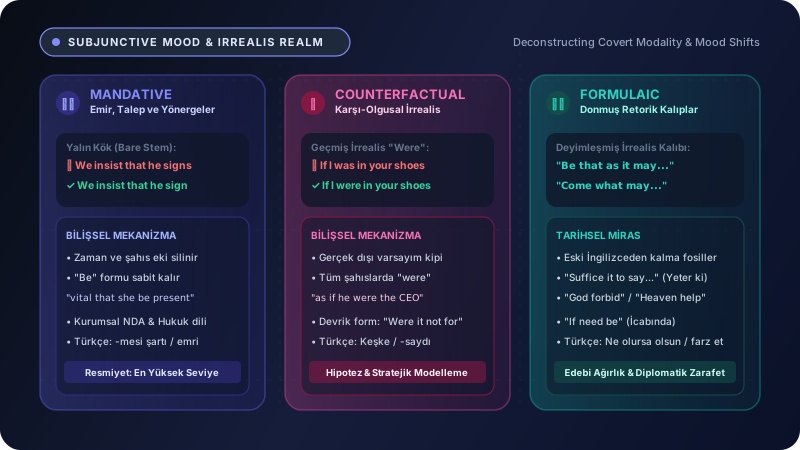
The Quietly Enduring Linguistic Instrument: Why the "Dead" Mood Rules Modern Governance
Countless learners and bilingual executives have encountered a reassuring yet profoundly misleading platitude in intermediate language seminars: "You needn't worry about the subjunctive in modern English; it died out centuries ago and survives only as a fossil in Romance languages."
Then reality intervenes. You sit down in a Zurich or Manhattan boardroom to review a cross-border merger agreement, a software licensing master contract, or an institutional arbitration award, and you encounter this exact syntactic construction:
"The Governance Board demands that the Chief Executive resign immediately and that all proprietary algorithms be placed under external escrow."
You pause to examine the constituent architecture: "The subject is singular third-person (the Chief Executive), yet where is the inflectional '-s' morpheme? Why 'resign' instead of 'resigns'? Furthermore, 'algorithms' is a plural noun—why does a bare uninflected 'be' stand in place of 'are' or 'were'?"
In that precise moment, you are confronting one of the most authoritative instruments in Germanic syntax: The Subjunctive Mood (The Realm of Irrealis). Far from being an archaic relic, it constitutes the grammatical backbone of Anglo-American corporate law, executive governance, and high-stakes diplomatic drafting.
The Cognitive Dimension: Realis versus Irrealis Worlds
Human cognition stratifies the external universe into two distinct ontological domains:
1. Realis (The Fact-Based World)
Encompasses events situated on a verifiable timeline that have transpired or are actively transpiring. This domain is strictly governed by the Indicative Mood.
"The forensic auditor is examining the transactions."
The auditor is physically situated at the desk, actively performing the task in realis time.
2. Irrealis (The Hypothetical / Mandated World)
Pertains to scenarios that do not yet exist on a timeline—representing volition, institutional mandate, hypothetical condition, or ethical necessity. This domain is encoded by the Subjunctive Mood.
"We insist that an independent auditor examine the transactions."
The audit has not occurred. We are constructing an irrealis requirement projected from volition.
To distinguish between what is factually true (realis) and what is mandated or imagined (irrealis), the English language executes a radical morphological intervention: It systematically strips all tense markers and subject-verb agreement inflections. The predicate is reduced to its primordial, uninflected bare stem.
Cross-Linguistic Contrast: Covert Stripping versus Overt Morphology
Linguistic friction arises because Turkic and Slavic languages encode modality through explicit, overt suffixes (such as Turkish -meli/-malı for obligation or -se/-sa for conditions). In contrast, English expresses irrealis modality covertly by deleting suffixes:
- Stylistic Contamination (Indicative Intrusion): "It is crucial that she submits the audit report before midnight." (Reads as casual, colloquial, or drafting carelessness in executive contexts.)
- Pristine Mandative Subjunctive: "It is crucial that she submit the audit report before midnight." (Projects unassailable institutional precision.)
The Three Pillars of the Modern English Subjunctive
| Category | Functional Domain | Exemplar Sentence |
|---|---|---|
| 1. Mandative Subjunctive | Governed by verbs and adjectives of urgency, mandate, and recommendation (demand, require, recommend, imperative, vital). | "It is imperative that every director be vetted." |
| 2. Counterfactual Were | Hypothetical conditions contrary to present or future fact (if, as though, wish). | "Were the counterparty to default, our credit line would absorb the impact." |
| 3. Formulaic Subjunctive | Frozen syntactic idioms originating in Early Modern English that preserve uninflected root structures. | "Be that as it may, our governance obligations remain absolute." |
The Transatlantic Divergence: American Preservation versus British Indicative Drift
A fascinating sociolinguistic divergence unfolded across the Atlantic during the nineteenth and twentieth centuries. In British English, speakers increasingly substituted the modal periphrasis "should + bare infinitive" or reverted entirely to the indicative (e.g., "We recommend that she should resign" or "We recommend that she resigns").
American English, by contrast, vigorously retained the Classical Mandative Subjunctive. Because American commercial norms dominate global software documentation, international banking covenants, and Wall Street capital markets, the uninflected bare stem has solidified its status as the supreme international benchmark:
// Wall Street & International Covenants Benchmark
"The committee mandated that the acquisition proceed without structural delay."
Counterfactual Irrealis: Resolving "If I was" versus "If I were"
While colloquial casual speech frequently tolerates "If I was in your position...", deploying that construction in institutional leadership undermines your rhetorical authority. Linguistically, "was" indexes realis past factual status:
- "If I was insensitive during yesterday's briefing, I unreservedly apologize." → Here, the possibility that I was insensitive is an open empirical question regarding realis history. "Was" is semantically correct.
- "If I were you, I would immediately restructure the debt portfolio." → I cannot literally occupy your physical personhood; the scenario is an unadulterated counterfactual abstraction. "Were" is not merely stylistic polish; it is ontological accuracy.
Four High-Impact Formulaic Subjunctives for Executive Discourse
Incorporate these four idiomatic relics into your written and spoken repertoire to immediately enhance your rhetorical sophistication:
- Be that as it may: Concedes an interlocutor's point without compromising your overarching strategic premise.
- Come what may: Communicates non-negotiable resolve in corporate or strategic commitments.
- Suffice it to say that...: Efficiently encapsulates complex background information without cluttering executive bandwidth.
- If need be: Signals prudent contingency readiness without introducing unnecessary alarm.
Next time you draft a critical commercial memo or present to executive governance, resist the reflex to default to colloquial indicative formulations. Harness the clean, uninflected authority of the Subjunctive; your prose will instantly radiate the unmistakable gravitas of seasoned leadership.
Download Vocabulary Guide For This Article
Download our custom-made printable PDF study sheet featuring all the essential vocabulary related to this topic.

Hakan Dağ
Founder & Language Architect
Software Engineer and English Instructor with 15+ years of experience in IT and education technology. Passionate about merging smart tools with genuine pedagogy.
Related Posts
Come or Go? The Hidden Point of View Behind Come, Go, Bring and Take
In Turkish, 'yarın sana geliyorum' feels straightforward. In English, come and go can shift depending on where the speaker, listener, or meeting point sits in the mental map. The same small map controls bring and take. This is a practical way to feel the direction instead of memorising four isolated rules.
Where Turkish -miş Disappears in English: The Moment You State as Fact Something You Only Heard
In a Monday standup someone said, 'The investor pulled out.' The room went quiet. They had only seen a Slack rumor. In Turkish the same sentence would have been 'Yatırımcı çekilmiş', and everyone would have heard that the source was indirect. English has no such ending. With Wallace Chafe's 1986 distinction, Aksu-Koç and Slobin's 'unprepared mind', and four doors you can actually use in a meeting: I saw it, I infer it, I heard it, I just found out.
Why Is It the Big Bad Wolf and Never the Bad Big Wolf? English's Unwritten Ear Rules
No English-speaking child is ever taught adjective order, yet none of them says 'a green old French car'. Why tick-tock is never tock-tick, why ping-pong is never pong-ping: same secret. From Mark Forsyth's famous example to the subjectivity research of Scontras, Degen and Goodman, from Cooper and Ross's 'me first' principle to ablaut reduplication, we explore English's unwritten ear rules, why they confuse Turkish speakers, and one practical rule of thumb that actually works.
💬 Discussion0
You must log in to comment.
Put Learning into Practice!
Improve your vocabulary with WordMaster, practice with an AI tutor.
Start for Free