Can You Learn English in Your Sleep? The Secret of Your Brain's Night Shift
"Listen while you sleep, wake up fluent!" That claim is nonsense. But the real role sleep plays in language learning? Much bigger than you think.
Listen to Article (High-Definition Audio)
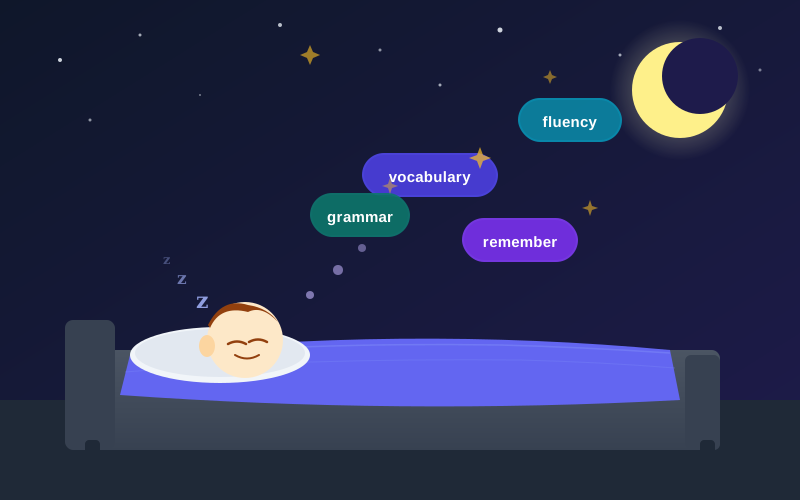
I'm sure you've seen this kind of ad before: "Listen through headphones while you sleep, and wake up to fluent English in the morning!" Spoiler: That's complete nonsense. Passive listening while sleeping is a claim with no scientific backing.
But that's not the end of the story. Because sleep actually plays a massive role in language learning. It's just that those ads get the role completely wrong.
Have You Ever Wondered What Your Brain Does at Night?
The moment you close your eyes, the work in your brain doesn't stop. On the contrary, stepping away from "active learning mode" kicks off another critical function: memory consolidation. Simply put — information you learned during the day gets moved from short-term to long-term memory while you sleep.
Think of it this way. During the day, you're uploading information to your brain. At night, your brain compresses those files, organizes them into proper folders, and saves them to the hard drive. If you don't get enough sleep, that saving process stays incomplete. And those new words? They get lost in temporary storage.
The Real Secret: The "Pre-Sleep Study Window"
Many studies show that information learned right before sleep stays in long-term memory far longer than things learned in the middle of the day. Why? Because sleep reduces the gap between learning and consolidation to near zero. Without interrupting stimuli — social media, TV, phone calls — in between, the new words you just learned start being processed immediately.
To put this into practice, try this: every night, 20-30 minutes before bed, work on just 10 new words or 5 new English sentences. Make meaning connections, use them in a sentence, say them out loud. Then put down the phone and sleep. You'll be surprised how many you remember in the morning.
REM Sleep and Language: Are You Dreaming in English?
At a more advanced stage of language learning, some students experience something strange: they start dreaming in English. This is actually the most concrete sign that your brain has internalized the language. REM sleep — the deep dreaming phase — is closely tied to emotional memory. When you form an emotional bond with a language, when you feel it not just as a tool but as a part of yourself, the brain stores it not like a procedure but like an identity.
That's why connecting stories, emotions, or images to the words you learn isn't just a memorization technique. It's also preparing much more "processable" packages for your brain's night shift.
How Many Hours Should You Sleep?
The answer isn't surprising: 7-9 hours for adults. But here's the interesting part — research shows that chronic sleep deprivation (less than 6 hours) significantly reduces the capacity to learn new language patterns. In short, people who stay up all night memorizing words might actually be hurting themselves.
This is also the real reason why cramming the night before an exam is ineffective. A tired brain can't consolidate information. Two nights of regular sleep plus 40 minutes of focused study is absolutely worth more than one 8-hour marathon in a single night.
A Practical Note
When planning your WordMaster sessions, keep this in mind: short but regular sessions spread throughout the day are always better than one long session. And if possible, make the last of those short sessions just before bed. Your brain will handle the rest.
Good night — and we hope you dream in English.
Download Vocabulary Guide For This Article
Download our custom-made printable PDF study sheet featuring all the essential vocabulary related to this topic.

Hakan Dağ
Founder & Language Architect
Software Engineer and English Instructor with 15+ years of experience in IT and education technology. Passionate about merging smart tools with genuine pedagogy.
Related Posts
Language Fossilization: Why You Have Been Making the Same Mistake for Years (and Nobody Told You)
'I am agree', 'discuss about', 'informations'... You have spoken English for years, you get understood, you may even run good meetings, yet a handful of errors seem carved in stone. Larry Selinker named it 'fossilization' in 1972: an interlanguage that stops growing exactly where communication stops demanding more. We look at why it happens, which errors tend to harden in Turkish speakers, and how 'noticing' can finally crack the shell.
Stephen Krashen's Affective Filter Hypothesis and the Neurobiology of Linguistic Freeze: How the Amygdala Shuts Down Adult Speech Production
Why do highly credentialed professionals who comprehend 95% of written English and possess rich vocabularies suddenly freeze the moment an impromptu question is directed at them in an international meeting? Drawing upon Stephen Krashen's foundational Second Language Acquisition (SLA) Monitor Model and contemporary cognitive neuroscience, we investigate the amygdala hijack behind linguistic paralysis, dismantle adult perfectionism, and present an actionable '80% Adequacy Protocol' to lower the affective filter permanently.
The Math of Understanding: The 98% Rule, Word Frequency, and Why the Right 3,000 Words Beat 10,000 Random Ones
Knowing 90% of the words in a text sounds great. In reality, it means one unknown word in every line, and it turns reading into a struggle. Using numbers and visuals, we explain the hidden threshold linguists call "coverage," what Zipf's law means for vocabulary learning, and how to choose your word list wisely.
💬 Discussion0
You must log in to comment.
Put Learning into Practice!
Improve your vocabulary with WordMaster, practice with an AI tutor.
Start for Free