Stephen Krashen's Affective Filter Hypothesis and the Neurobiology of Linguistic Freeze: How the Amygdala Shuts Down Adult Speech Production
Why do highly credentialed professionals who comprehend 95% of written English and possess rich vocabularies suddenly freeze the moment an impromptu question is directed at them in an international meeting? Drawing upon Stephen Krashen's foundational Second Language Acquisition (SLA) Monitor Model and contemporary cognitive neuroscience, we investigate the amygdala hijack behind linguistic paralysis, dismantle adult perfectionism, and present an actionable '80% Adequacy Protocol' to lower the affective filter permanently.
Listen to Article (High-Definition Audio)
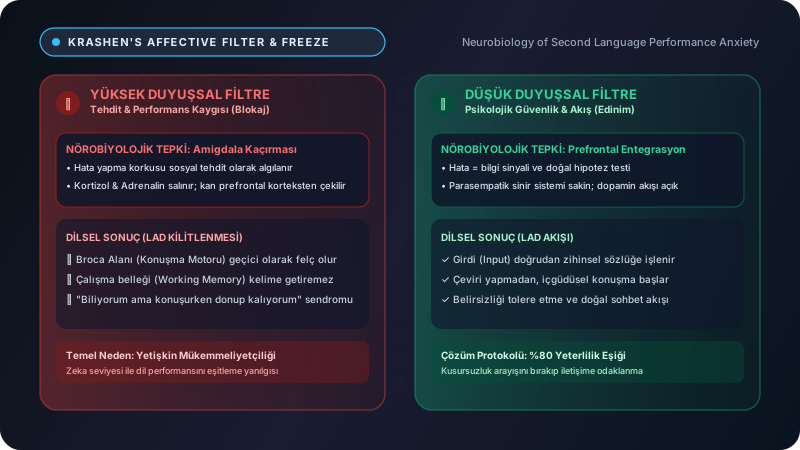
The Profound Intellectual Crisis of High-Performing Adults: "I Understand Everything, Yet I Freeze"
Consider an accomplished engineering director, investment partner, or corporate strategist who commands cross-functional divisions and decodes dense data sets with effortless acuity. When handed an exhaustive 40-page technical specification or legal prospectus in English, they comprehend 95% without consulting a dictionary. When listening to specialized industry podcasts, nuance rarely escapes them.
Yet in an unexpected moment during a cross-border Zoom steering committee with counterparts in London or San Francisco, an impromptu question lands squarely on their shoulders:
"Hey, what are your initial thoughts on the regional infrastructure bottlenecks? Can you walk us through the rollout risks?"
In that microsecond, a catastrophic physiological shutdown occurs: The throat constricts. Heart rate surges. Rich lexical reserves and syntactic precision—crystal-clear moments prior—vanish behind an impenetrable fog. From their lips emerge only disjointed, stammering fragments: "Uhh... yes... we have... problem... like... you know..."
When the session concludes, a wave of bitter humiliation and cognitive dissonance descends: "Am I losing my intellectual edge? I know this domain intimately! The vocabulary was in my brain—why couldn't my vocal cords synthesize it?"
The diagnostic reality is liberating: You lack neither cognitive capacity nor lexical breadth. You experienced an acute Neurobiological Amygdala Hijack accompanied by what Second Language Acquisition (SLA) scholars designate as an Impenetrable Affective Filter.
Stephen Krashen and the Foundations of the Affective Filter Hypothesis
During the early 1980s, University of Southern California applied linguist Prof. Stephen Krashen transformed second language scholarship by formulating the Monitor Model, proving a revolutionary tenet:
"Conscious learning and natural acquisition represent fundamentally distinct psychological architectures. Regardless of how many abstract grammatical rubrics a learner memorizes, if their 'Affective Filter' is elevated, comprehensible input cannot penetrate the Language Acquisition Device (LAD), and spontaneous speech synthesis remains paralyzed."
According to Krashen's empirical framework, three primary psychological toxins elevate this invisible barrier:
- Evaluative Anxiety: The existential apprehension that syntactic errors will trigger loss of professional credibility or intellectual standing.
- Deficient Self-Efficacy: The debilitating cognitive distortion that one lacks innate linguistic facility.
- The Over-Active Monitor: Compulsive perfectionism that insists on mentally vetting every sentence through three internal grammatical audits before vocalization.
The Neuroscience of Speech Paralysis: The Brain Misinterprets Grammatical Errors as Physical Threat
Pioneering neurobiological research by Joseph LeDoux illuminates the physiological mechanics underlying this conversational paralysis:
The Amygdala's Social Threat Detection
For an accomplished adult professional, making a public grammatical blunder is experienced not as an educational trial, but as an existential threat to status, authority, and tribal belonging.
The primal limbic system cannot differentiate between an awkward preposition and a physical predator.
Prefrontal Deactivation and Broca's Shutdown
The hypothalamic-pituitary-adrenal (HPA) axis saturates the bloodstream with cortisol and epinephrine. Blood shunts away from the dorsolateral prefrontal cortex toward visceral survival centers.
Broca's area—the motor speech engine—loses metabolic support. Working memory retrieval collapses completely.
Why Toddlers Acquire Effortlessly While Accomplished Adults Freeze
Observe a two-year-old child acquiring their native tongue. When they desire an object or attempt to describe an event, they entertain zero awareness of syntactic categories or aspectual morphology. They conflate tenses, invert word order, invent words, and laugh uproariously. Their affective filter rests at zero because social evaluative fear has not yet colonized their psyche.
Furthermore, child language acquisition incorporates an extended, months-long developmental phase known as the "Silent Period". The child listens intensely, calibrating internal phonological representations and intonational baselines without the premature demand for performance. When production eventually begins, it emerges organically from cognitive surplus.
Adult learners, by contrast, are routinely subjected to premature production demands from day one. Stripped of an adequate Silent Period, the adult brain reflexively erects defensive psychological scaffolding.
The "80% Adequacy Protocol": Four Steps to Dismantle the Filter
To deactivate the limbic alarm and transition from cognitive paralysis into natural communicative fluency, implement these four evidence-based protocols:
1. Herbert Simon's "Satisficing" Rule: Adequacy over Perfection
Adopt the satisficing principle formulated by Nobel laureate Herbert Simon: Maximization breeds cognitive paralysis. In spontaneous leadership communication, your objective is 80% semantic clarity, not 100% textbook elegance. If you deploy 'at' instead of 'in', your counterparts still extract the essential operational truth. If the message lands, communication has triumphed.
2. Dial the Internal Monitor Down by 50%
Strive for what Krashen termed the "Optimal Monitor User." Banish the internal courtroom prosecutor that scrutinizes each syllable before vocal release. When you register a minor inflectional error mid-sentence, resist the compulsion to execute sudden repairs. Maintain forward momentum; real-world conversation favors flow over retrospective editing.
3. Somatic Regulation: Diaphragmatic Reset and the Three-Second Bridge
When an unexpected question is directed your way, never vocalize from an empty lung. Take a deliberate nasal breath, release muscular tension in your shoulders, and deploy an executive bridge phrase: "That is a nuanced dimension. Let's disaggregate it into two structural priorities." That three-second buffer reassures the amygdala that safety prevails, keeping Broca's area online.
4. Zero-Risk Shadowing in Solitude
In environments devoid of social judgment (in your vehicle or during a morning walk), listen to an articulate podcast and shadow the speaker with a one-second delay. When your articulatory musculature normalizes the physical rhythm of fluent production without social scrutiny, the freeze reflex in boardroom settings dissolves naturally.
Linguistic fluency in high-stakes environments is never a function of accumulating obscure vocabulary. It is the liberation of the knowledge you already possess from the defensive grip of performance anxiety. Lower the internal threshold, ground your physiology, and trust your voice to carry your ideas with unshakeable authenticity.
Download Vocabulary Guide For This Article
Download our custom-made printable PDF study sheet featuring all the essential vocabulary related to this topic.

Hakan Dağ
Founder & Language Architect
Software Engineer and English Instructor with 15+ years of experience in IT and education technology. Passionate about merging smart tools with genuine pedagogy.
Related Posts
Language Fossilization: Why You Have Been Making the Same Mistake for Years (and Nobody Told You)
'I am agree', 'discuss about', 'informations'... You have spoken English for years, you get understood, you may even run good meetings, yet a handful of errors seem carved in stone. Larry Selinker named it 'fossilization' in 1972: an interlanguage that stops growing exactly where communication stops demanding more. We look at why it happens, which errors tend to harden in Turkish speakers, and how 'noticing' can finally crack the shell.
The Math of Understanding: The 98% Rule, Word Frequency, and Why the Right 3,000 Words Beat 10,000 Random Ones
Knowing 90% of the words in a text sounds great. In reality, it means one unknown word in every line, and it turns reading into a struggle. Using numbers and visuals, we explain the hidden threshold linguists call "coverage," what Zipf's law means for vocabulary learning, and how to choose your word list wisely.
Sleep, the Forgetting Curve & the Night Shift: The Neurological Circuit That Fixes Words During Sleep
When German psychologist Hermann Ebbinghaus discovered the forgetting curve in 1885, he named humanity's age-old problem. But did you know you can fix words not just by studying, but by sleeping? We decode sleep's hidden night shift in memory.
💬 Discussion0
You must log in to comment.
Put Learning into Practice!
Improve your vocabulary with WordMaster, practice with an AI tutor.
Start for Free