Language Fossilization: Why You Have Been Making the Same Mistake for Years (and Nobody Told You)
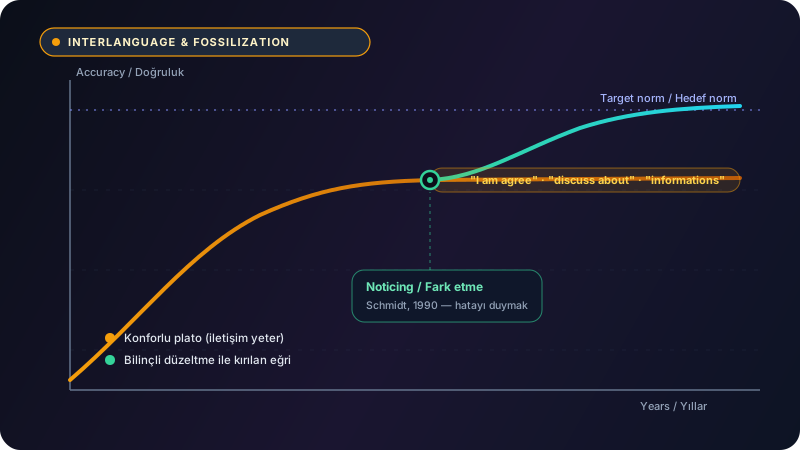
'I am agree', 'discuss about', 'informations'... You have spoken English for years, you get understood, you may even run good meetings, yet a handful of errors seem carved in stone. Larry Selinker named it 'fossilization' in 1972: an interlanguage that stops growing exactly where communication stops demanding more. We look at why it happens, which errors tend to harden in Turkish speakers, and how 'noticing' can finally crack the shell.
Listen to Article (High-Definition Audio)
The Little Message After the Meeting
I have a friend (I will keep the name out of it, they will know). They have worked with overseas teams at a software company for years. Fluent English, jokes that land, presentations that keep a room quiet. Last year a British colleague sent a private note after a meeting: "You're great. Just a tiny thing: we don't say 'discuss about', just 'discuss'."
My friend told me this over the phone, half laughing and half wincing: "I have been saying it for eleven years. Eleven! Nobody ever said a word."
What stings in that story is not the mistake itself. It is that nothing stopped it for eleven years. The sentence was understood. People nodded. Communication worked. And language, it turns out, stops learning where it works.
Linguists have a name for this: fossilization.
Selinker's 1972 Idea: Learners Speak a Language of Their Own
In his 1972 paper "Interlanguage", Larry Selinker proposed something striking. A learner is not speaking their mother tongue, and not quite the target language either. They speak a third system with its own rules and its own internal logic: an interlanguage. It is consistent from the inside. It just does not fully match the target.
Most interlanguages drift closer to the target over time. Selinker noticed something else, though. In some learners, certain forms refused to move no matter how many classes they sat through. A learner might even use a form correctly for a while and then slide back to the old error, which he called backsliding. He called these frozen forms fossils, and he guessed that only a small minority of adult learners (he floated a figure under five percent) ever reach full target-like command. That number is debated and was never a precise measurement, but the weight of the idea stands.
A caveat: researchers like Michael Long find "fossil" too rigid and prefer "stabilization", because a fossil is permanent while these errors can be dislodged under the right conditions. That is the good news, and we will get to it.
Fossil or ordinary slip?
Ordinary slip: Sometimes you say it right, sometimes wrong. When someone points it out you say "Oh, of course!"
Fossil: Same form, every time, for years, without noticing. Even after correction it is back by the next sentence.
Why Does It Stop Exactly There?
There is no single cause, more of a committee of causes. The ones that come up most often in the research:
- The "good enough" trap. Once the message gets through, the brain goes into saving mode. Cognitive resources are limited, so the system hands everything that works to autopilot. An error on autopilot is the hardest kind to fix.
- First-language transfer. A pattern from your mother tongue leaks into the target language and settles. The earlier the leak starts, the deeper it sets.
- Missing feedback. Among adults, politeness beats correction. People will not fix you as long as they understand you. That was my friend's eleven years.
- Social identity. Some researchers point out that a learner can grow attached to their own "voice" in the language and be reluctant to give it up. How we speak is partly who we are.
- Not noticing. Maybe the biggest one. Richard Schmidt's 1990 Noticing Hypothesis argues that you have to notice a feature before you can acquire it. What you do not notice does not get in.
Schmidt's Own Experiment, and the Case of "Wes"
Schmidt did not leave the theory on a shelf; he tested it on himself. While learning Portuguese in Brazil he kept a diary and saw that he started using a form only after he noticed it. However often it floated past him in conversation, it did not enter his own sentences until his mind flagged it.
"Wes", a case he studied earlier, is the mirror image: a Japanese painter living in Hawaii who learned English as an adult and communicated with great energy. He bargained, joked, steered conversations. Yet his grammar barely changed over years. He used the language richly in daily life and still never picked up certain forms. Communicative success did not guarantee development, and sometimes it got in the way.
Fossils Turkish Speakers Often Carry
Every language pair has its own fossil garden. These are the ones I meet most often in Turkish speakers of English. Notice that each has a logic; none is random.
| Fossil | Target form | Why it hardens |
|---|---|---|
| discuss about | discuss the plan | Turkish says "hakkında tartışmak": the postposition is required, so "about" arrives on its own. |
| informations / advices | information / advice | Turkish "bilgiler" and "tavsiyeler" are countable. In English these nouns are not. |
| I am agree | I agree | An overgeneralization from "I am sure / I am glad": be seems to belong before anything adjective-like. |
| explain me / say me | explain it to me / tell me | Turkish says "bana anlat": the dative ending attaches straight to the verb. English "explain" and "say" need "to" before the person. |
| He don't / She have | He doesn't / She has | Turkish verbs change with every subject, but "third person singular" does not feel like a special category, so the -s sounds redundant and drops. |
| I live here since 2019 | I have lived here since 2019 | Turkish says "2019'dan beri yaşıyorum": the simple present is enough. English needs present perfect. |
| missing / misplaced "the" | I need a pen / Open the window | Turkish has no articles. A whole topic of its own, but a quick note: this is one of the longest-living fossils. |
None of these errors blocks understanding. That is exactly why none of them fixes itself. Vicious circle.
Cracking the Shell: Five Practical Moves
Fossilization is not fate. But "study more English" is poor advice here, because fossils are by definition the problem of people who already speak a lot. Something different is needed: targeted attention.
- Make a three-error list. Trying to fix fifty things at once ends in quitting. Pick three. Only three. Put them in your phone notes under a title like "What I'm fighting this month".
- Borrow an outside ear. An honest friend, a teacher, or your own voice on a recording. Meeting recordings are made for this; listening to yourself is uncomfortable at first and very educational.
- Slow down the target form. When the problem structure approaches (say "discuss..."), pause for a full second on purpose. Switching off autopilot is the only way to break an automated pattern.
- Push your output. Merrill Swain's 1985 Output Hypothesis argues that the moment you try to say something and get stuck is itself what triggers learning. Make yourself build hard sentences: explain an idea out loud and watch where you stumble.
- Hear the right form, inside your own life. Collect real sentences with "discuss" and no "about": headlines, emails, podcast transcripts. Then write ten of your own. Memorizing a rule is not enough; you need to hear it in your own context.
A tiny experiment (try it this week)
Record your next meeting (with permission) and hunt for just one of your errors. Count how many times you make it. If the number surprises you, you have found a fossil. That number is the starting line for fixing it.
And Please, Be Kind to Yourself
Do not read this and spiral into "have I been speaking wrongly for years?". A fossilized error does not mean your English is bad. Quite the opposite: you got far enough to communicate, and the language let you off the hook at that point. A plateau is a sign of success; the trouble is only when you move in and furnish it.
Back to my friend: after that message, they spent four months catching "discuss about" every single day on purpose. These days they fix about ninety percent of the time. Still slips occasionally, and that is fine. A fossil does not lift overnight, but one day you notice the language feels less like a load you carry and more like a toy you hold.
This week, write down your three. Time will handle the rest.
Download Vocabulary Guide For This Article
Download our custom-made printable PDF study sheet featuring all the essential vocabulary related to this topic.

Hakan Dağ
Founder & Language Architect
Software Engineer and English Instructor with 15+ years of experience in IT and education technology. Passionate about merging smart tools with genuine pedagogy.
Related Posts
Stephen Krashen's Affective Filter Hypothesis and the Neurobiology of Linguistic Freeze: How the Amygdala Shuts Down Adult Speech Production
Why do highly credentialed professionals who comprehend 95% of written English and possess rich vocabularies suddenly freeze the moment an impromptu question is directed at them in an international meeting? Drawing upon Stephen Krashen's foundational Second Language Acquisition (SLA) Monitor Model and contemporary cognitive neuroscience, we investigate the amygdala hijack behind linguistic paralysis, dismantle adult perfectionism, and present an actionable '80% Adequacy Protocol' to lower the affective filter permanently.
The Math of Understanding: The 98% Rule, Word Frequency, and Why the Right 3,000 Words Beat 10,000 Random Ones
Knowing 90% of the words in a text sounds great. In reality, it means one unknown word in every line, and it turns reading into a struggle. Using numbers and visuals, we explain the hidden threshold linguists call "coverage," what Zipf's law means for vocabulary learning, and how to choose your word list wisely.
Sleep, the Forgetting Curve & the Night Shift: The Neurological Circuit That Fixes Words During Sleep
When German psychologist Hermann Ebbinghaus discovered the forgetting curve in 1885, he named humanity's age-old problem. But did you know you can fix words not just by studying, but by sleeping? We decode sleep's hidden night shift in memory.
💬 Discussion0
You must log in to comment.
Put Learning into Practice!
Improve your vocabulary with WordMaster, practice with an AI tutor.
Start for Free