The Art of Filling the Void: 7 Natural English Fillers to Buy Thinking Time Without Sounding Awkward
Don't freeze in awkward panic when searching for a word. Discover the cognitive conversational cushions native speakers use to buy thinking time while sounding thoughtful, composed, and fluent.
Listen to Article (High-Definition Audio)
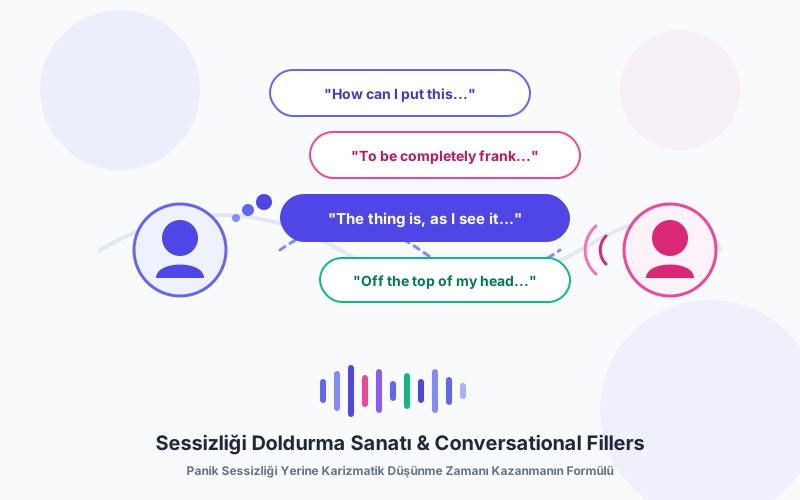
That Terrifying 4-Second Silence
We've all been there: You're in an important meeting or chatting with someone you just met at a café abroad. You started your sentence with great energy, everything was clicking, and then... boom. That one crucial word vanishes into the dark corners of your brain. Your mind slams on the emergency brakes. Your eyes freeze towards the ceiling, your heart rate spikes, and a chilling 4-second silence — which feels like 4 agonizing hours — engulfs the room.
How do we handle these moments in our native language? Without even thinking, we effortlessly cushion the silence with phrases like "well, you see...", "how should I put it...", "the thing is...". These vocal bridges grant our brains 2 to 3 seconds of breathing room, signaling to our listener: "I'm still right here with you, just thinking." But when we switch to English, we often lose this conversational reflex and freeze solid.
Here is the great news: Native English speakers search for words just as often as you do! The only difference is that instead of freezing in dead silence, they instinctively employ Conversational Cushions and Cognitive Fillers. These phrases transform a moment of hesitation from a perceived weakness into a mark of thoughtful composure and conversational charisma.
1. The Neurolinguistic Reality: Why Do We Freeze?
Linguistic research shows that when speaking a foreign language, the brain runs on double processors: it simultaneous organizes the core conceptual message while filtering grammar rules and lexical recall. Under this cognitive load, micro-pauses are completely natural.
However, when you vocalize a natural discourse filler instead of falling into dead silence, cortisol levels in the brain's Broca's area drop. The conversational cadence remains intact. Let's add these golden cushions to your daily toolkit.
2. Seven Golden Fillers That Turn Hesitation into Charisma
1. "How can I put this..." / "How shall I put it..."
Meaning: Refining or softening an explanation.
Used when you are searching for the most accurate or diplomatic way to phrase an idea. It portrays you as an articulate speaker who weighs words carefully rather than struggling.
Example: "The new strategy is, how can I put this... slightly overly ambitious for our current team."
2. "To be completely frank with you..." / "To be quite honest..."
Meaning: Establishing trust and directness.
Injects instant sincerity into your opening, gives you 3 seconds of recall time, and immediately hooks the listener's attention as they anticipate a candid insight.
Example: "To be completely frank with you, I haven't looked at the revised budget yet."
3. "The thing is..." / "Here's the thing..."
Meaning: Introducing the core explanation or hurdle.
One of the most authentic everyday bridges in both British and American English. It effortlessly sets up an obstacle, reason, or underlying motive.
Example: "I'd love to join the dinner, but the thing is, my flight gets in quite late."
4. "If memory serves me right..." / "As far as I recall..."
Meaning: Recalling past facts without claiming infallibility.
Instead of staring blankly while trying to remember dates or specifics, drop this smooth phrase. It protects you from factual slips while maintaining an unbroken cadence.
Example: "If memory serves me right, we discussed this in last quarter's retrospective."
5. "Off the top of my head..."
Meaning: Giving an immediate estimate without prior calculation.
A lifesaver in meetings when someone suddenly asks for figures or rough timeframes. It relieves the pressure of delivering exact precision on the spot.
Example: "Off the top of my head, I'd say we need at least three more weeks."
6. "It's on the tip of my tongue..."
Meaning: Acknowledging a temporary memory lapse warmly.
When a word truly eludes you, admitting it with a smile disarms the room. It invites empathy, and nine times out of ten, your listener will chime in to help you out.
Example: "Wait, don't tell me... his name is on the tip of my tongue!"
7. "What I'm trying to get at is..."
Meaning: Refocusing a winding point.
Whenever you feel yourself rambling or losing the thread mid-sentence, this phrase pulls everything back together with authority.
Example: "It's not that we lack resources; what I'm trying to get at is our priorities need shifting."
3. Common Traps to Steer Clear Of
While fillers are essential, balance is key. Watch out for these two habitual traps:
- Overusing "Like": Saying "like... and then like..." every few words can sound uncertain and unpolished in professional or serious discussions.
- Repetitive "You know?": Constantly seeking validation at the end of every clause weakens your point. Replace it with a calm, confident pause.
4. Intonation and Body Language: The Silent Signal
Never dart your eyes anxiously around the room when using these fillers. Slightly tilt your head, maintain relaxed eye contact, and let your tone soften. When delivered smoothly, the pause looks like deep cognitive contemplation rather than panic.
💡 WordMaster Practice Drill:
Pick any spontaneous topic today (e.g., "What is your favorite holiday memory?"). Before answering out loud, deliberately begin with "Well, off the top of my head..." or "How can I put this...". Practice for 2 minutes over 3 consecutive days to build this natural fluency reflex into your muscle memory.
True fluency is not speaking at breakneck speed without a single pause. Real fluency is owning your pauses with poise and presence. Next time a word slips away, take a breath, smile, and say: "How can I put this..."
Download Vocabulary Guide For This Article
Download our custom-made printable PDF study sheet featuring all the essential vocabulary related to this topic.

Hakan Dağ
Founder & Language Architect
Software Engineer and English Instructor with 15+ years of experience in IT and education technology. Passionate about merging smart tools with genuine pedagogy.
Related Posts
The 'Did They Hear Me?' Feeling on Video Calls: Lag, Silence and the Rhythm of Turn-Taking in English
In face-to-face talk, the gap between turns averages around 200 milliseconds, shorter than a blink. On a video call that rhythm breaks, silences stretch, and our brains blame the person across the screen rather than the technology. With Stivers's ten-language study, Deborah Tannen's 'high-involvement' and 'high-considerateness' styles, backchannels and ready-to-use English phrases, we decode the invisible rhythm of remote conversation.
Acoustic Charisma and Pitch Contour Modulation in Executive English: Why Fluency Alone Fails to Command the Room
Why do internationally credentialed professionals who speak fluent, grammatically pristine English still get interrupted in multinational boardrooms or struggle to project commanding authority? Drawing on acoustic phonetics, prosodic hierarchy, and executive voice analytics, we examine the intonational clash between Turkish syllable-timed cadence and English stress-timed contour, dissect the career-limiting 'Uptalk' trap, and reveal how mastering the Terminal Falling Contour commands psychological closure and boardroom gravitas.
The Disappearing Sounds of Rapid English: An Acoustic Map of Elision, Assimilation, and Connected Speech
Why do fluent English speakers sound like an unbroken wave of noise even when you know every single word in isolation? The culprit isn't your vocabulary; it's the fundamental collision between syllable-timed Turkish rhythm and stress-timed English acoustics. We map out the phonetic mechanics of elision (dropped sounds), assimilation (mutating consonants), and intrusive liaison links that native ears process automatically.
💬 Discussion0
You must log in to comment.
Put Learning into Practice!
Improve your vocabulary with WordMaster, practice with an AI tutor.
Start for Free