The 'Did They Hear Me?' Feeling on Video Calls: Lag, Silence and the Rhythm of Turn-Taking in English
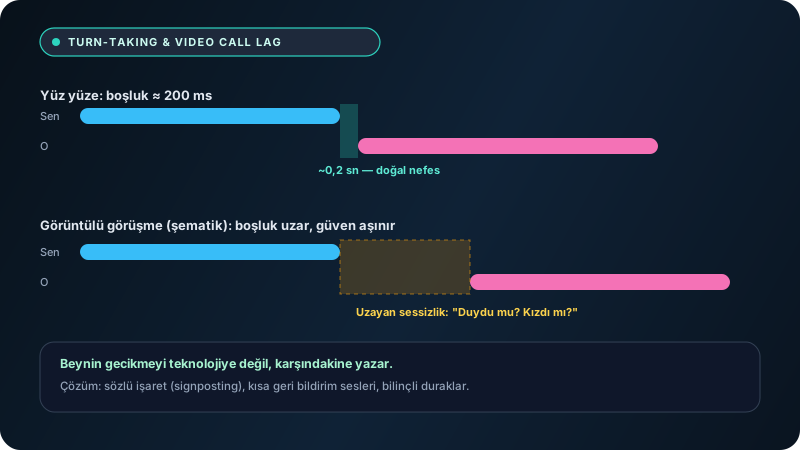
In face-to-face talk, the gap between turns averages around 200 milliseconds, shorter than a blink. On a video call that rhythm breaks, silences stretch, and our brains blame the person across the screen rather than the technology. With Stivers's ten-language study, Deborah Tannen's 'high-involvement' and 'high-considerateness' styles, backchannels and ready-to-use English phrases, we decode the invisible rhythm of remote conversation.
Listen to Article (High-Definition Audio)
That Three-Second Silence
You know the scene. You are on a video call and you have just asked a question. Faces on the screen, nobody moves. One, two, three seconds. A voice inside says: "Was my question wrong? Did it freeze? Are they annoyed with me?"
Then someone answers as though nothing happened. Something did happen: the connection lagged half a second, the other person opened their mic at exactly that moment, yours opened too, and you both started and stopped together. Nobody was angry with anybody. But the little knot you felt in those three seconds is real, and science takes it seriously.
The Hidden Metronome of Human Conversation: 200 Milliseconds
In 2009 Tanya Stivers and colleagues published a study in PNAS that is easy to love. They measured natural conversation in ten languages (English, Japanese, Danish, Lao, Tzeltal and others). The finding was surprising: the time between one person stopping and the next starting averaged around 200 milliseconds across all of them. That is shorter than a blink.
Cultural differences were small but real. Japanese sat at the shortest end (a handful of milliseconds), Danish at the longest (roughly 470 ms). Yet even that gap is less than half a second. Whatever the language, humanity talks to the same metronome.
Even more interesting: preparing a sentence can take the brain more than 600 milliseconds (Stephen Levinson's work shows this). So if you answer within 200 ms, you started preparing your reply before the other person finished theirs. Conversation does not run in strict turns; it runs on overlapping predictions. While we listen, we are already getting ready to speak.
What Breaks on a Video Call?
That finely tuned rhythm wobbles once audio and video delay enter. Julie Boland and colleagues' 2021 study of conversations over Zoom found that gaps between turns stretched by roughly a hundred milliseconds compared with in-person talk, overlaps became rarer, and people felt the conversation ran more stiffly. Each loss looks tiny, a few dozen milliseconds, but conversational rhythm is that sensitive.
What is stranger is how our brains interpret it. A 2014 study by Schoenenberg, Raake and Egger found that as network delay grew, participants rated the person at the other end as less friendly and less attentive. When someone is slow to answer, your brain does not say "the internet is slow." It says "this person is unenthusiastic." Delay gets written onto the other person's character.
Keep this in mind
A good part of the tension you feel in remote meetings is technical, not personal. But the brain converts it into something personal. Knowing that is the first step toward being gentler with yourself and with the person on the screen.
An Extra Layer for Turkish Speakers
The linguist Deborah Tannen splits conversational styles into two broad types. In a high-involvement style, speakers talk fast, interrupt in support of each other, overlap, and treat all that as a way of showing interest. In a high-considerateness style, a person waits for the other to finish, leaves a gap, and treats cutting in as rude.
Turkish chats often feel closer to the first: three people at a tea table talk at once and nobody minds; it is a sign of closeness. Many English-speaking workplaces, especially around the UK and Scandinavia, lean toward the second. When the two rhythms meet in one meeting, one side's "respectful waiting" collides with the other's "enthusiastic joining in".
Video calls make it harder. Overlap is often silenced by the technology: one of you gets cut off, and the one who "interrupted" is you. This raises the risk of looking rude. So in remote meetings it helps to slow your in-person habits a little and use verbal signals when cutting in.
Small Sounds, Big Difference: Backchannels
In face-to-face talk you keep showing you are listening with small signals: you nod, say "mm-hm", raise your eyebrows. Linguists call these backchannels. On a video call, with your mic muted or a lag in the line, those signals vanish and the speaker feels like they are talking to a wall.
The fix has two layers: visual when muted (nod, a slight smile) and verbal when unmuted, very short:
- "Mm-hm." · "Right." · "Got it." · "Makes sense." · "I see."
- When dense information is coming: "Okay, so if I'm following..."
- Short agreement: "Yeah, exactly." · "That's fair."
Ready-Made English: A Pocket Guide for Meetings
Here are natural, everyday phrases for taking the floor, giving it back, and handling lag gracefully in remote meetings:
| Situation | What you say |
|---|---|
| You want the floor | "Can I jump in for a second?" · "Sorry, may I add something?" · "Quick thought, if I may." |
| You both spoke at once | "Sorry, you go ahead." · "After you." · "No, please, finish your thought." |
| Lag cut you off | "Sorry, the lag got me. I was saying..." · "Let me pick that back up." |
| You asked, and silence followed | "I'll give that a moment, there's a bit of delay on my end." |
| Handing over the turn clearly | "That's my main point. Over to you, Maria." · "I'll stop there and open it up." |
| You did not catch it | "Sorry, you cut out for a second. Could you repeat the last part?" |
| You will talk for a while | "I have three quick points. First..." (Counting up front tells people when you will finish.) |
Verbal Navigation: Signposting
This may be the most valuable remote-speaking skill: show the road at the start of a sentence. Since others cannot read the nuance from your face, you need to say out loud what you are about to do.
- "Let me give you the short version first, then the details."
- "I want to flag one risk."
- "Before I forget, one quick thing on the budget."
- "To sum up where we are..."
These sentences do more than tidy things up. They tell the listener "I am not finished", which also stops the person poised to pounce on a silence.
Making Friends with the Pause
One more thing: slow down your own internal silence counter. In face-to-face chat, a half-second silence means "done". On a video call the same half second is just lag. After you ask a question, count to three in your head and do not rush to fill it. Those three seconds are not a technical loss; they are a courtesy, giving the other person room to think and to outlast the delay.
As the speaker, try a small trick too: when you finish a point, let your sentence fall at the end and add a short "So." or "Okay." A falling voice and one tiny word are the most natural way to say "your turn".
Three Mini Exercises for This Week
- The three-second rule: After asking a question, count to three silently. Uncomfortable but instructive.
- Backchannel hunt: In an English meeting or podcast, count the small sounds the other side makes while the speaker talks. "Mm-hm", "right", "yeah"... how often do they come?
- Signposting log: In your next meeting, start at least two sentences with "Let me..." and notice what happens.
Remote talk is not simply delayed face-to-face talk; it is a new environment with its own rhythm and its own manners. The good news: you do not need a perfect accent or a huge vocabulary to learn it. A little patience, a few short phrases, and the habit of not taking someone's silence personally are plenty. Next time that three-second silence arrives, take a breath. Most likely nobody is angry with you; the packet is just on its way.
Download Vocabulary Guide For This Article
Download our custom-made printable PDF study sheet featuring all the essential vocabulary related to this topic.

Hakan Dağ
Founder & Language Architect
Software Engineer and English Instructor with 15+ years of experience in IT and education technology. Passionate about merging smart tools with genuine pedagogy.
Related Posts
Acoustic Charisma and Pitch Contour Modulation in Executive English: Why Fluency Alone Fails to Command the Room
Why do internationally credentialed professionals who speak fluent, grammatically pristine English still get interrupted in multinational boardrooms or struggle to project commanding authority? Drawing on acoustic phonetics, prosodic hierarchy, and executive voice analytics, we examine the intonational clash between Turkish syllable-timed cadence and English stress-timed contour, dissect the career-limiting 'Uptalk' trap, and reveal how mastering the Terminal Falling Contour commands psychological closure and boardroom gravitas.
The Disappearing Sounds of Rapid English: An Acoustic Map of Elision, Assimilation, and Connected Speech
Why do fluent English speakers sound like an unbroken wave of noise even when you know every single word in isolation? The culprit isn't your vocabulary; it's the fundamental collision between syllable-timed Turkish rhythm and stress-timed English acoustics. We map out the phonetic mechanics of elision (dropped sounds), assimilation (mutating consonants), and intrusive liaison links that native ears process automatically.
Why You Sound Like a Robot in English: The Elusive Schwa /ə/ and the Rhythmic Heartbeat of Fluency
Turkish treats every syllable with egalitarian cadence; English ruthlessly compresses unstressed vowels into the elusive schwa /ə/. Unlocking this single phonetic reality is the dividing line between robotic cadence and effortless fluency.
💬 Discussion0
You must log in to comment.
Put Learning into Practice!
Improve your vocabulary with WordMaster, practice with an AI tutor.
Start for Free