Acoustic Charisma and Pitch Contour Modulation in Executive English: Why Fluency Alone Fails to Command the Room
Why do internationally credentialed professionals who speak fluent, grammatically pristine English still get interrupted in multinational boardrooms or struggle to project commanding authority? Drawing on acoustic phonetics, prosodic hierarchy, and executive voice analytics, we examine the intonational clash between Turkish syllable-timed cadence and English stress-timed contour, dissect the career-limiting 'Uptalk' trap, and reveal how mastering the Terminal Falling Contour commands psychological closure and boardroom gravitas.
Listen to Article (High-Definition Audio)
The Invisible Barrier in Global Boardrooms: Flawless Grammar, Zero Gravitas
Across multinational corporations, tech ecosystems, and cross-border consulting engagements, a deeply frustrating paradox plays out daily for thousands of extraordinarily capable non-native professionals:
Your preparation is airtight. Your syntactic architecture is pristine. Your command of specialized technical terminology is unquestionable. You deliver your contribution with uninterrupted fluency. Yet somehow, the gravitational center of the room slips right past you. You are frequently interrupted. A strategic recommendation you put forward is met with polite silence, only for an American or British counterpart to reframe precisely the same idea ten minutes later to resounding executive acclaim: "Brilliant insight, Mark—let's operationalize that."
In those moments of alienation, high-achieving professionals reflexively fall into a common misdiagnosis: "My English must still be lacking. I need to memorize more advanced idioms or eliminate my accent."
The empirical reality of speech science reveals that the breakdown is neither lexical nor grammatical. The friction is located in the fundamental frequency modulation of your vocal cords—your F0 Pitch Contour. In high-stakes international leadership, authority is decoded not merely through semantic definitions, but through the musical physics of your vocal cadence. Phonologists refer to this as Acoustic Charisma.
The Prosodic Collision between Turkish and English
When a professional raised in a syllable-timed linguistic background speaks English, they instinctively transpose the prosodic architecture of their native tongue onto the target language. This collision operates along two fundamental axes:
Turkish Prosodic Profile (Syllable-Timed)
• Isochronous syllable duration: Each syllable commands roughly equivalent metric real estate (a steady, rapid cadence: da-da-da-da).
• Narrow fundamental frequency bandwidth: Speech flows along a comparatively flat, disciplined intonational plane.
• Sentence boundaries frequently terminate in neutral suspension or delicate elevation.
English Prosodic Profile (Stress-Timed)
• Tonic stress timing: Stressed syllables expand dramatically; unstressed functional words contract into reduced vowels (Schwa cadence: DA..da..DA..da).
• Expansive pitch excursions: The voice swoops across wide octave registers to signal focal information.
• Declarative assertions demand an authoritative downward plunge at the terminal boundary.
The Executive Death Sentence: The "Uptalk" Trap (High-Rising Terminal)
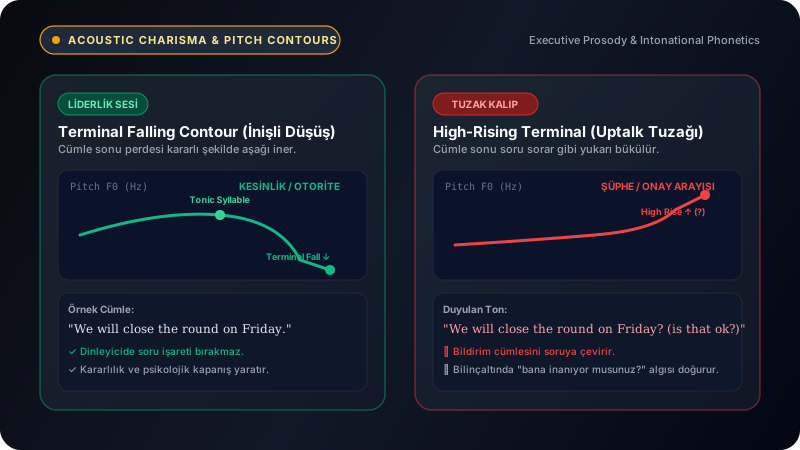
The most pervasive acoustic pattern that sabotages executive presence among international professionals is Uptalk (technically termed High-Rising Terminal). Uptalk occurs when a speaker bends the final syllable of a declarative assertion upward, mimicking the melodic contour of an interrogative question.
The Career-Limiting Briefing:
"Our Q3 financial projections are completely on track? And we will deliver the platform by November? So we can start onboarding clients?"
The speaker believes they are delivering three confident strategic updates. However, the ascending pitch contour (↑) transmits a subconscious distress flare to native listeners: "I lack certainty in my own numbers; am I allowed to say this? Please validate my existence."
When you conclude an affirmative statement with an upward pitch inflection in an executive boardroom, the listener's brain unconsciously concludes that you have not finished your thought, or worse, that you are seeking permission. This is the single most common cause of untimely interruptions: counterparts do not perceive that they are cutting you off; they interpret your rising pitch as an invitation to resolve your perceived hesitation.
The Voice of Authority: The Terminal Falling Contour
Acoustic analysis of world-class leaders, senior diplomats, and commanding CEOs reveals an unmistakable acoustic signature: the Terminal Fall.
The Terminal Fall is the deliberate downward inflection of pitch onto the chest resonance at the culmination of an assertion:
"We have audited the operational debt. The thesis is sound. We will proceed with the acquisition." ↓ (Full stop. Closure achieved. Authority established.)
When your voice lands decisively at the bottom of your vocal range, you generate cognitive closure in the room. Counterparts instinctively hold their breath, absorbing the weight of the assertion. This acoustic posture is not arrogance; it is the physiological signal that someone is willing to stand behind their words.
Three Actionable Drills to Recalibrate Your Acoustic Charisma
Before stepping into your next cross-border presentation or compensation negotiation, calibrate your vocal instrument using these three principles:
-
The Two-Second Authority Gap: Resist the urge to rush into your subsequent thought the millisecond you finish a sentence. Banish vocalized filler debris ("uhh", "you know", "and so"). Drive the final syllable downward into a Terminal Fall, and maintain unbroken silence for two full seconds. That acoustic vacuum reminds every participant in the room who commands the floor.
-
Locate the Tonic Syllable on the Core Argument: Rather than allowing pitch to drift until the end of the sentence, place your highest frequency peak on the pivotal lexical item, then cascade downward: "We must FOCUS on regulatory compliance" (FOCUS hits the melodic summit; compliance descends to baseline).
-
Record and Trace Your Pitch Contours: Open your smartphone's voice memo app and record yourself reading a paragraph of executive correspondence. As you listen, trace the contour of your pitch with a pen on paper. Do your sentence endings curl skyward (↑), or do they anchor firmly into the table (↓)? The day your lines learn to land downward is the day your international presence transforms forever.
Commanding a room in global English is not a function of accumulating obscure vocabulary. It is the art of granting the words you already possess the acoustic gravity they deserve. Lower your terminal pitch, ground your breath, and let your assertions land with unshakeable resolve.
Download Vocabulary Guide For This Article
Download our custom-made printable PDF study sheet featuring all the essential vocabulary related to this topic.

Hakan Dağ
Founder & Language Architect
Software Engineer and English Instructor with 15+ years of experience in IT and education technology. Passionate about merging smart tools with genuine pedagogy.
Related Posts
The Disappearing Sounds of Rapid English: An Acoustic Map of Elision, Assimilation, and Connected Speech
Why do fluent English speakers sound like an unbroken wave of noise even when you know every single word in isolation? The culprit isn't your vocabulary; it's the fundamental collision between syllable-timed Turkish rhythm and stress-timed English acoustics. We map out the phonetic mechanics of elision (dropped sounds), assimilation (mutating consonants), and intrusive liaison links that native ears process automatically.
Why You Sound Like a Robot in English: The Elusive Schwa /ə/ and the Rhythmic Heartbeat of Fluency
Turkish treats every syllable with egalitarian cadence; English ruthlessly compresses unstressed vowels into the elusive schwa /ə/. Unlocking this single phonetic reality is the dividing line between robotic cadence and effortless fluency.
The First 60 Seconds: Neuro-Linguistic Secrets of Executive English Openings
Why 'Good morning, today I'll talk about...' induces immediate cognitive slumber. Explore the 4 neuro-linguistic opening frameworks deployed by world-class leaders to capture rapt executive attention.
💬 Discussion0
You must log in to comment.
Put Learning into Practice!
Improve your vocabulary with WordMaster, practice with an AI tutor.
Start for Free