Calibrating English Social Distance: Why Saying 'Please' Can Still Sound Rude and How to Soften Your Tone
Why does saying 'Give me the report, please' make international colleagues flinch? Explore Brown & Levinson's Politeness Theory and master the art of diplomatic softening.
Listen to Article (High-Definition Audio)
The Chilling Cold Shower on Zoom
Following an illustrious career in Turkey, Ahmet joined a multinational tech enterprise as a Senior Product Manager. His English was technically robust; his grammar was pristine, and he articulated complex distributed systems with ease. Yet at the conclusion of his inaugural month, his director delivered unexpected feedback:
"Ahmet, your architectural insight is world-class, but in team ceremonies you come across as slightly overly authoritative and demanding."
Ahmet was stunned. He audited his sent emails and meeting recordings. He had placed a prominent "Please" at the end of virtually every single request! "Send me the user metrics, please." "Fix this bug by tomorrow, please." "Listen to my presentation, please." What could possibly be more polite than saying 'please'?
Herein lies one of the profound paradoxes of cross-cultural pragmatics: In English, tacking 'please' onto an imperative never converts a command into a polite request. More often than not, it creates a patronizing, impatient, and passive-aggressive sting.
1. Brown & Levinson's Model: "Social Face" and Wiggle Room
Established sociolinguistic Politeness Theory posits that every human maintains a "social face"—an intrinsic desire to be respected and free from imposition. When you issue a raw imperative verb, appending 'please' does not erase the infringement; you have still restricted their agency.
In Anglo-Saxon communication, genuine courtesy resides in granting the listener dignified wiggle room—the psychological safety to say no or negotiate terms. Consequently, articulate speakers cushion their requests through deliberate layers of hedging and softening.
2. The 5-Tier Politeness Ladder
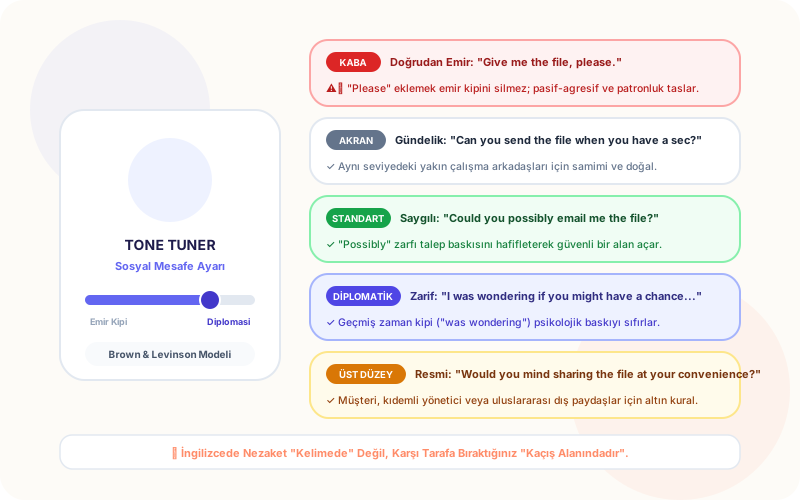
Let us examine how the identical intent ("Send me the file") transforms across five distinct social distances:
Tier 1
Raw Imperative (Blunt & Risky)
"Send me the file, please."
⚠️ Resonance: "This is my entitlement and you must comply immediately." Suitable only for military drill sergeants or parents addressing toddlers.
Tier 2
Casual Peer Collaboration
"Can you send the file when you have a sec?"
✓ Resonance: Natural and effortless when messaging a close peer with whom you share daily rapport.
Tier 3
Professional Standard
"Could you possibly email me the file?"
✓ Resonance: The adverb "possibly" works wonders by honoring the colleague's workload and time constraints.
Tier 4
Diplomatic Softening
"I was wondering if you might have a chance to look over the file?"
✓ Resonance: Shifting into the past tense ("was wondering", "might") creates respectful psychological space. The executive gold standard.
Tier 5
Executive Grace & Client Stewardship
"Would you mind sharing the file at your earliest convenience?"
✓ Resonance: Placing timing entirely at the partner's discretion. Flawless corporate diplomacy.
3. The Secret Shortcut: Tense Distance Creates Courtesy
The fastest cognitive trick to soften any English request is simply to shift your tense backward in time:
- Replace "I wonder if..." with "I was wondering if..."
- Replace "Do you have a minute?" with "Did you have a quick moment?"
- Replace "Can you look?" with "Could you take a look?"
Past tense grammatically creates psychological detachment, transforming an urgent demand into a gracious invitation.
🤝 The Takeaway:
Language does not merely convey logistics; it calibrates power dynamics and emotional safety. To command genuine influence in an international arena, stop overburdening the word "Please". Grant your colleagues room to breathe, and watch how enthusiastically they support your vision.
Download Vocabulary Guide For This Article
Download our custom-made printable PDF study sheet featuring all the essential vocabulary related to this topic.

Hakan Dağ
Founder & Language Architect
Software Engineer and English Instructor with 15+ years of experience in IT and education technology. Passionate about merging smart tools with genuine pedagogy.
Related Posts
The 'Did They Hear Me?' Feeling on Video Calls: Lag, Silence and the Rhythm of Turn-Taking in English
In face-to-face talk, the gap between turns averages around 200 milliseconds, shorter than a blink. On a video call that rhythm breaks, silences stretch, and our brains blame the person across the screen rather than the technology. With Stivers's ten-language study, Deborah Tannen's 'high-involvement' and 'high-considerateness' styles, backchannels and ready-to-use English phrases, we decode the invisible rhythm of remote conversation.
Acoustic Charisma and Pitch Contour Modulation in Executive English: Why Fluency Alone Fails to Command the Room
Why do internationally credentialed professionals who speak fluent, grammatically pristine English still get interrupted in multinational boardrooms or struggle to project commanding authority? Drawing on acoustic phonetics, prosodic hierarchy, and executive voice analytics, we examine the intonational clash between Turkish syllable-timed cadence and English stress-timed contour, dissect the career-limiting 'Uptalk' trap, and reveal how mastering the Terminal Falling Contour commands psychological closure and boardroom gravitas.
The Disappearing Sounds of Rapid English: An Acoustic Map of Elision, Assimilation, and Connected Speech
Why do fluent English speakers sound like an unbroken wave of noise even when you know every single word in isolation? The culprit isn't your vocabulary; it's the fundamental collision between syllable-timed Turkish rhythm and stress-timed English acoustics. We map out the phonetic mechanics of elision (dropped sounds), assimilation (mutating consonants), and intrusive liaison links that native ears process automatically.
💬 Discussion0
You must log in to comment.
Put Learning into Practice!
Improve your vocabulary with WordMaster, practice with an AI tutor.
Start for Free