English Verb Patterns: -ing or to? The Invisible Compass That Flips Meaning
A learner said 'I stopped to smoke' in a meeting and the room heard the opposite of what he meant. Turkish says 'sigara içmeyi bıraktım' with one pattern; English makes the verb choose between -ing and to + verb, and that choice can flip the meaning. Here is why remember, forget, stop, try and regret tell two different stories, solved with one mental compass instead of a list to memorise.
Listen to Article (High-Definition Audio)
A Sentence That Flipped in a Meeting
In a consulting call, at the end of a long day, a man told his client: "I stopped to smoke last year." His face was serious. The client paused, then smiled: "So you started again?" The consultant tried to explain, but the damage was done. What he meant was that he had quit smoking. What he said was that he had paused in order to smoke.
In Turkish, this trap is almost impossible. We say "sigara içmeyi bıraktım" and it is finished. The verb is bırakmak, its object is içmek, and the relationship between them is built with a single suffix. English takes the second action through one of two doors: -ing or to + verb. Most of the time both are correct and the meaning stays the same. But with some verbs, the choice of door changes the whole story.
I am not going to hand you a long list to memorise. Instead, I want to build one compass you can open in your head while you speak. Because the real question is not "which verb takes which pattern." The real question is how you are seeing the action.
Two Doors, One Question
When a second action follows a verb in English, it takes one of two forms:
- -ing (gerund): I enjoy reading. — The action looks like a thing, an activity.
- to + verb (infinitive): I want to read. — The action looks like a goal, a direction.
Turkish has no such split. In "okumayı seviyorum" and "okumak istiyorum", the verb okumak keeps the same shape; what makes it a "thing" or a "goal" is the first verb. English moves that job onto the shape of the second verb. In other words, English hands the second verb a costume, while Turkish leaves the costume to the first verb.
The first needle of the compass asks: Is this action a finished activity, or a direction not yet taken? An activity leans toward -ing; a direction leans toward to.
The short compass
-ing = the action itself (activity, experience, process)
to + verb = the direction of the action (goal, purpose, next step)
Do not ask "which verb takes which." Ask "am I seeing this action as a thing or as a direction?"
Three Families: Only -ing, Only to, and Both
Sorting verbs into three families clears the map fast. The families are not random; each has a logic behind it.
Family one — only -ing. These are usually verbs of enjoyment, avoidance, finishing, continuing — verbs that see the action as an experience or a process: enjoy, avoid, finish, mind, suggest, keep, practise, consider, imagine, risk. We say "I enjoy swimming", never "I enjoy to swim". What you enjoy is not a goal; it is an activity you live through.
Family two — only to. These are verbs of wanting, deciding, planning, promising — verbs that see the action as a direction not yet taken: want, decide, hope, plan, promise, agree, refuse, offer, manage, afford. We say "I decided to leave", never "I decided leaving". A decision is a step toward something that has not happened yet.
Family three — both. Here there are two sub-groups. In one, the meaning barely changes: begin, start, continue, like, love, hate, prefer. "I started to work" and "I started working" say the same thing. In the other, the meaning changes — and that is where the real story begins.
The Five Verbs That Flip Meaning
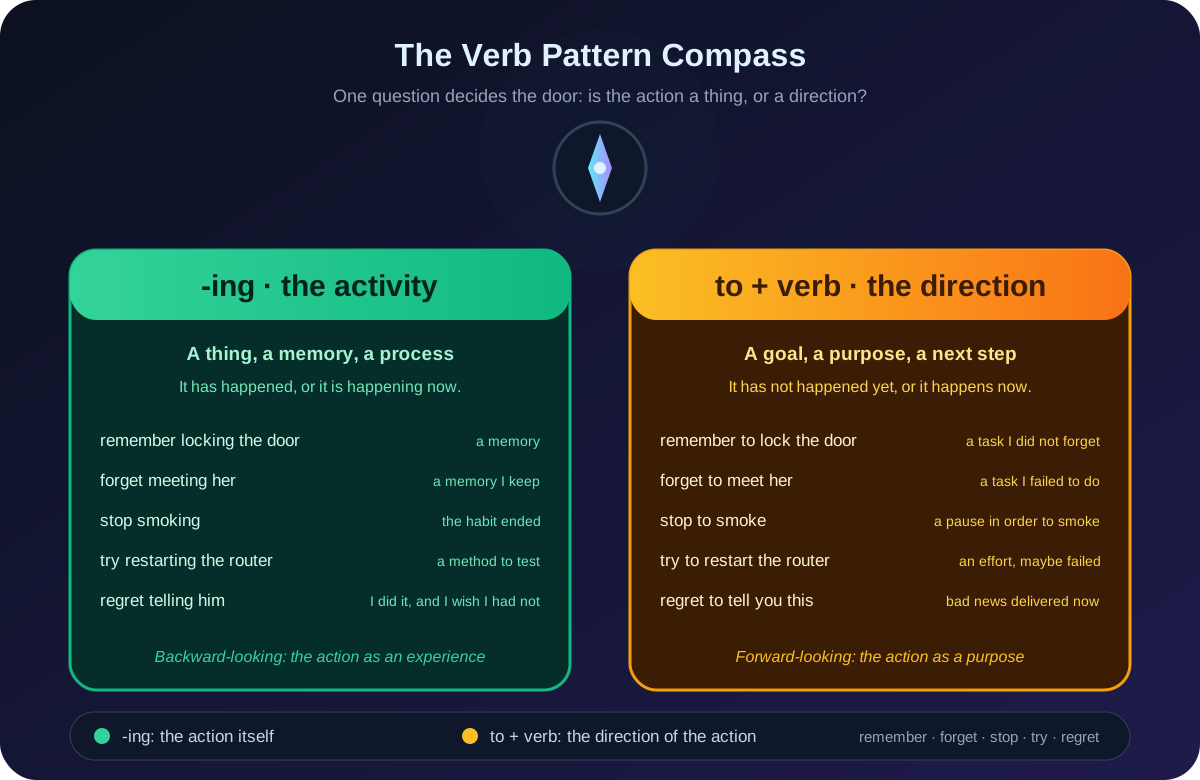
Here is the famous five: remember, forget, stop, try, regret. In the same sentence they can build two different worlds. The difference is where the compass needle points: a backward-looking activity, or a forward-looking purpose.
| Verb | + -ing (activity / past) | + to (purpose / next step) |
|---|---|---|
| remember | I remember locking the door. A memory: I did it and recall it. | I remembered to lock the door. A task: I did not forget to do it. |
| forget | I'll never forget meeting her. A memory I keep. | I forgot to meet her. A task I failed to do. |
| stop | He stopped smoking. The habit ended. | He stopped to smoke. He paused in order to smoke. |
| try | Try restarting the router. A method to test. | I tried to restart the router. An effort; maybe it failed. |
| regret | I regret telling him. I did it and wish I had not. | I regret to tell you this. I am telling you now, reluctantly. |
Look closely at the table: the left column always points to something that has happened, the right column always points to something about to happen or happening now. For remember and forget, the left is a memory and the right is a task. For stop, the left is the end of a habit and the right is a pause. For try, the left is a method to test and the right is an effort. For regret, the left is a backward-looking apology and the right is bad news delivered now.
Why It Feels So Confusing
Because Turkish does not carry this split inside the verb. The difference between "Kapıyı kilitlediğimi hatırlıyorum" and "Kapıyı kilitlemeyi hatırladım" is built by the clause in front of hatırlamak; English uses the same verb in two different costumes. While your brain thinks in Turkish, "to remember" is one single idea. English splits it in two: remembering a memory and remembering a task.
That is why Turkish speakers make two mistakes most often:
- Hiding in one pattern: always using to, as in "I remember to lock." Sometimes correct, sometimes the wrong meaning.
- Never noticing the difference: saying "I stopped to smoke" while meaning "I quit." The listener hears the opposite.
The good news: you do not need to memorise these five verbs one by one. The compass already gives the answer. If the action is a memory or an activity, use -ing; if it is a task, purpose, or next step, use to.
Using the Compass at Work
This distinction shows up constantly in everyday office English. Notice why each pattern is chosen below:
- "I'll never forget presenting to that client." — A memory. You did it; it lives in your mind.
- "I forgot to send the invoice." — A task. The invoice was never sent.
- "We stopped using that vendor." — A practice that ended.
- "We stopped to review the numbers." — We paused in order to review.
- "Try asking the support team." — A method to test.
- "I tried to reach him all morning." — An effort; perhaps you never got through.
The same logic runs through email. "I regret to inform you that the deadline has moved" tells the reader you are delivering bad news now. "I regret informing you so late" tells them you are sorry you were late. Both are correct; each tells a different story.
The Three-Second Decision Test
You have no time to think about grammar while speaking. These three questions work better:
- Has this action happened, or is it happening? If so, consider -ing.
- Has it not happened yet — is it a goal? If so, to + verb is more likely.
- Is the verb one of the five that flip? If so, build both sentences in your head and pick the one you mean.
And keep one practical rule: when you see stop, remember, forget, try, regret, pause for a second. These five are where the compass spins fastest.
A Seven-Day Noticing Exercise
For one week, collect three sentences a day. Open two headings in your notes: Activity (-ing) and Direction (to). Place the sentences you hear or build:
- I enjoy learning new tools.
- I want to learn a new tool.
- She kept talking.
- She decided to talk to him.
Then ask yourself for each one: is the action a thing or a direction? After a week, the choice stops being a conscious decision and becomes something your ear simply expects.
Verb patterns in English are not grammar rules; they are choices of viewpoint. The same action can be seen as a memory or as a goal. Once you build the compass, the choice between -ing and to stops being a dictionary question and becomes a question of intention. And a speaker who knows their intention picks the right pattern.
Download Vocabulary Guide For This Article
Download our custom-made printable PDF study sheet featuring all the essential vocabulary related to this topic.

Hakan Dağ
Founder & Language Architect
Software Engineer and English Instructor with 15+ years of experience in IT and education technology. Passionate about merging smart tools with genuine pedagogy.
Related Posts
Come or Go? The Hidden Point of View Behind Come, Go, Bring and Take
In Turkish, 'yarın sana geliyorum' feels straightforward. In English, come and go can shift depending on where the speaker, listener, or meeting point sits in the mental map. The same small map controls bring and take. This is a practical way to feel the direction instead of memorising four isolated rules.
Where Turkish -miş Disappears in English: The Moment You State as Fact Something You Only Heard
In a Monday standup someone said, 'The investor pulled out.' The room went quiet. They had only seen a Slack rumor. In Turkish the same sentence would have been 'Yatırımcı çekilmiş', and everyone would have heard that the source was indirect. English has no such ending. With Wallace Chafe's 1986 distinction, Aksu-Koç and Slobin's 'unprepared mind', and four doors you can actually use in a meeting: I saw it, I infer it, I heard it, I just found out.
Why Is It the Big Bad Wolf and Never the Bad Big Wolf? English's Unwritten Ear Rules
No English-speaking child is ever taught adjective order, yet none of them says 'a green old French car'. Why tick-tock is never tock-tick, why ping-pong is never pong-ping: same secret. From Mark Forsyth's famous example to the subjectivity research of Scontras, Degen and Goodman, from Cooper and Ross's 'me first' principle to ablaut reduplication, we explore English's unwritten ear rules, why they confuse Turkish speakers, and one practical rule of thumb that actually works.
💬 Discussion0
You must log in to comment.
Put Learning into Practice!
Improve your vocabulary with WordMaster, practice with an AI tutor.
Start for Free