Your Introversion Isn't a Barrier: The Quiet Advantage in Learning English
"Speak more, learn more." That advice doesn't fit everyone. A look at the advantages introverted learners actually have — the ones nobody really talks about.
Listen to Article (High-Definition Audio)
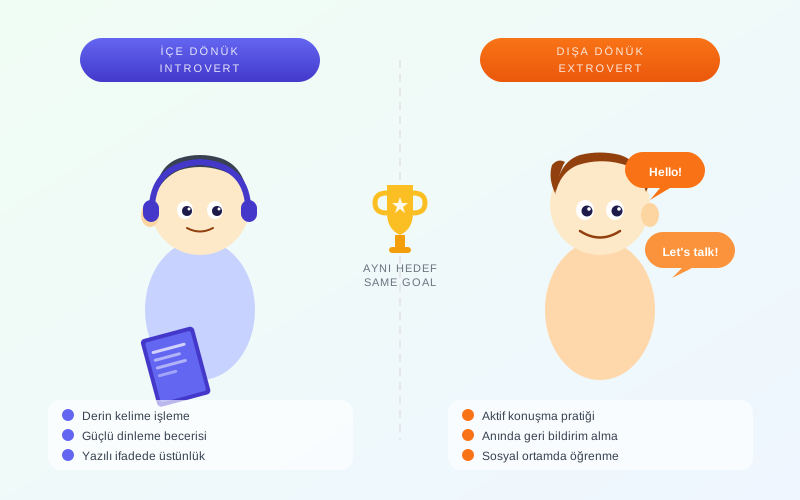
There's a piece of advice you hear constantly in language learning circles: "Speak! The more you speak, the more you learn!" That's great advice for extroverts. But what if you're the type who feels uncomfortable even asking strangers for directions on public transport? What if your mental energy comes not from social interactions, but from solitude?
Then this article is exactly for you. And here's what I want to tell you: your introversion is not a handicap in learning English. In fact, it carries real advantages that can put you ahead of extroverts in certain areas.
Let's Clarify One Thing First: What Is Introversion?
Introversion is not shyness. Introverted individuals may feel perfectly fine in social settings — it's just that their energy sources are different. While extroverts gain energy from social environments, introverts "recharge" by sitting alone after being around people for a while. This is a neurological difference, and it is absolutely not a flaw.
But in language learning culture, the "speak, speak, speak" mantra has become so dominant that the quieter learner profile is made to seem almost pathological. That's a big mistake.
The Real Advantages of Introverts in Language Learning
Deep Processing: Research shows that introverted individuals process information more deeply. Rather than staying on the surface, they instinctively examine the nuances of a word — its context of use, its different connotations. This contributes to vocabulary actually sticking. Those who seem to learn quickly but forget after a week are typically the shallow processors.
Quality Listening: Introverts are generally better listeners in social settings. In language learning, this is worth its weight in gold. Because truly hearing a language — noticing intonations, rhythm, and natural speech patterns — is just as critical for fluency as speaking. Maybe even more so.
Excellence in Written Communication: The modern world rewards quiet expression. Writing emails, preparing reports, messaging — in all of these, introverted individuals tend to use more careful, more structured language. And in a professional setting, this can become far more visible than verbal communication.
A Strategy to Motivate You: Create Your Own Space
If large group English classes drain you, the solution isn't to attend more — it's to shift toward different formats. One-on-one lessons, self-directed simulations (talking to a mirror is an old method, but it works), journaling, recording your own voice — all of these are formats extremely well-suited to the introverted learning style.
One suggestion: do 5-10 minutes of English reading aloud every day — actually out loud. A book, a news article, any text at all. This low-key but consistent practice will, over time, build both your pronunciation and your confidence. Without ever having to face a large crowd.
A Myth I Want to Debunk
"You're too afraid to speak anyway, so you can't learn."
No. Linguistics research shows that introverted and extroverted individuals achieve similar fluency levels over the long term. Their journeys just look different. Extroverts correct natural errors by speaking more; introverts speak less but more accurately by listening more and processing things internally.
Both paths lead to the same destination. Just choose whichever feels more natural to you.
One Last Thing
I hope the next time someone tells you "you should speak more," you'll smile quietly to yourself. Because you're already listening. And that's allowing you to learn far more than what's being said out loud.
Download Vocabulary Guide For This Article
Download our custom-made printable PDF study sheet featuring all the essential vocabulary related to this topic.
Sarah Jenkins
Native English Teacher & Accent Coach
TEFL certified instructor from London, helping students sound natural and confident in daily conversations. Expert in British pronunciation.
Related Posts
The 'Did They Hear Me?' Feeling on Video Calls: Lag, Silence and the Rhythm of Turn-Taking in English
In face-to-face talk, the gap between turns averages around 200 milliseconds, shorter than a blink. On a video call that rhythm breaks, silences stretch, and our brains blame the person across the screen rather than the technology. With Stivers's ten-language study, Deborah Tannen's 'high-involvement' and 'high-considerateness' styles, backchannels and ready-to-use English phrases, we decode the invisible rhythm of remote conversation.
Acoustic Charisma and Pitch Contour Modulation in Executive English: Why Fluency Alone Fails to Command the Room
Why do internationally credentialed professionals who speak fluent, grammatically pristine English still get interrupted in multinational boardrooms or struggle to project commanding authority? Drawing on acoustic phonetics, prosodic hierarchy, and executive voice analytics, we examine the intonational clash between Turkish syllable-timed cadence and English stress-timed contour, dissect the career-limiting 'Uptalk' trap, and reveal how mastering the Terminal Falling Contour commands psychological closure and boardroom gravitas.
The Disappearing Sounds of Rapid English: An Acoustic Map of Elision, Assimilation, and Connected Speech
Why do fluent English speakers sound like an unbroken wave of noise even when you know every single word in isolation? The culprit isn't your vocabulary; it's the fundamental collision between syllable-timed Turkish rhythm and stress-timed English acoustics. We map out the phonetic mechanics of elision (dropped sounds), assimilation (mutating consonants), and intrusive liaison links that native ears process automatically.
💬 Discussion0
You must log in to comment.
Put Learning into Practice!
Improve your vocabulary with WordMaster, practice with an AI tutor.
Start for Free