Building a Library in Your Mind: Advanced Memory Techniques (Mnemonics) for Vocabulary Retention
Are you tired of forgetting words two days after memorizing them? Unlock the doors of permanent memory with the Memory Palace and association techniques that hack our brain's forgetting curve.
Listen to Article (High-Definition Audio)
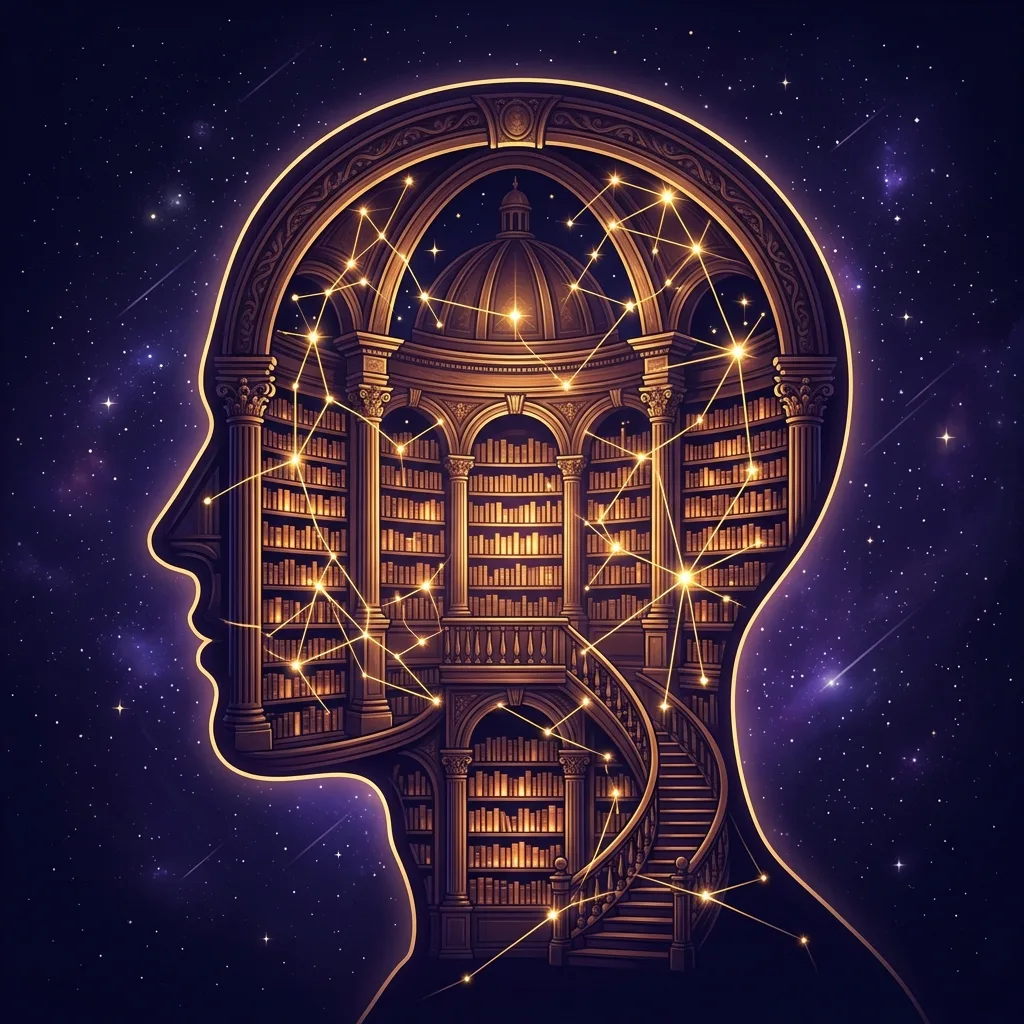
We all know that frustrating cycle very well: you study 20 new English words at night with great enthusiasm, feeling amazing. Two days later, when you encounter one of those words, a familiar feeling arises, but its meaning has flown out of your mind. You just stare blankly. Why does our brain forget words so easily? And more importantly, how can we hack this forgetting mechanism to our own advantage?
The answer lies in the evolutionary structure of the human brain. Our brain does not like dry information, heaps of letters, and dictionary definitions; it sees them as "garbage" and cleanses them during the first sleep cycle. What our brain is in love with, however, are visuals, emotions, spaces, and absurdities. Today, let's build a word library in your mind that will never decay, using the most powerful weapons of cognitive science.
Placing Words with the Memory Palace (Method of Loci)
Do you know what the secret was of Ancient Greek orators who delivered hours of flawless speeches without taking any notes? The Memory Palace. Our brain's spatial memory is hundreds of times stronger than our verbal memory. You can visualize how many rooms your childhood home has and the location of the furniture in seconds. This is where we will place the words.
Suppose you want to learn the word relentless (unyielding, merciless, persistent). Do this:
- Visualize the front door of your house in your mind.
- Imagine a highly ambitious, merciless knight trying to break that door down persistently with a giant hammer. Let the knight have "RELENTLESS" written on his armor.
- Every time you enter through that door, visualize that noise and that ambitious knight.
Next time you hear this word, your brain will recall not the dictionary definition, but that crazy knight at your front door. This bond formed between space and word never breaks.
Absurdity and Emotion Triggers (Mnemonics)
The most important factors determining the retention of information in memory are its emotional intensity and absurdity. We forget ordinary things, but we never forget highly bizarre, funny, or ridiculous things. Be as ridiculous as possible when forming word associations (mnemonics).
For example, let's take the word abundant (plentiful, rich, existing in large quantities). It sounds like "a-bun-dant". You can associate this with a funny local word or image, like a massive bakery filled with hot buns (Abundant of Buns!). Visualize a bakery exploding with a literal mountain of hot, delicious, glowing buns overflowing onto the street. Plentiful buns! Is it ridiculous? Yes, extremely. But your brain will instantly nail this absurdity to your memory board.
Active Recall vs. Passive Review
Looking at a word card and turning it over to read its meaning is passive review, and its effect is highly limited. What strengthens memory is not the effort the brain exerts while taking in that information, but the effort it spends while retrieving (trying to recall) that information.
Test yourself. Instead of reading the meaning of the word directly, give yourself clues and try to pull that word out of your mind by force. WordMaster's flashcards and smart quiz algorithms are built precisely on this scientific foundation. Rescue your brain from laziness; give it a gentle challenge.
Hack the Forgetting Curve
German psychologist Hermann Ebbinghaus's famous "Forgetting Curve" shows that 70% of newly learned information is forgotten within the first 24 hours. The only way to prevent this is the Spaced Repetition system. When you review a word on the 1st day, 3rd day, 7th day, and 30th day, that information leaves the temporary memory (short-term) and is carved into the marble floor of permanent memory (long-term).
Your mind is not a garbage dump, but a magnificent palace. Treat it as it deserves; don't just memorize words, exhibit them like works of art in the corridors of your mind. Happy learning!
Download Vocabulary Guide For This Article
Download our custom-made printable PDF study sheet featuring all the essential vocabulary related to this topic.

Mevlut Doger
Mathematics Tutor (30+ years)
Experienced and dedicated Mathematics Tutor with more than 30 years of teaching experience, supporting thousands of students across a wide range of ages and academic levels in the English and Scottish education systems.
Related Posts
Language Fossilization: Why You Have Been Making the Same Mistake for Years (and Nobody Told You)
'I am agree', 'discuss about', 'informations'... You have spoken English for years, you get understood, you may even run good meetings, yet a handful of errors seem carved in stone. Larry Selinker named it 'fossilization' in 1972: an interlanguage that stops growing exactly where communication stops demanding more. We look at why it happens, which errors tend to harden in Turkish speakers, and how 'noticing' can finally crack the shell.
Stephen Krashen's Affective Filter Hypothesis and the Neurobiology of Linguistic Freeze: How the Amygdala Shuts Down Adult Speech Production
Why do highly credentialed professionals who comprehend 95% of written English and possess rich vocabularies suddenly freeze the moment an impromptu question is directed at them in an international meeting? Drawing upon Stephen Krashen's foundational Second Language Acquisition (SLA) Monitor Model and contemporary cognitive neuroscience, we investigate the amygdala hijack behind linguistic paralysis, dismantle adult perfectionism, and present an actionable '80% Adequacy Protocol' to lower the affective filter permanently.
The Math of Understanding: The 98% Rule, Word Frequency, and Why the Right 3,000 Words Beat 10,000 Random Ones
Knowing 90% of the words in a text sounds great. In reality, it means one unknown word in every line, and it turns reading into a struggle. Using numbers and visuals, we explain the hidden threshold linguists call "coverage," what Zipf's law means for vocabulary learning, and how to choose your word list wisely.
💬 Discussion0
You must log in to comment.
Put Learning into Practice!
Improve your vocabulary with WordMaster, practice with an AI tutor.
Start for Free