Active Shadowing: The Secret Polyglot Technique for Accent and Rhythm
Passive listening is not enough; you must become the shadow of the sound. Learn how to apply the Shadowing technique to naturalize your speech rhythm.
Listen to Article (High-Definition Audio)
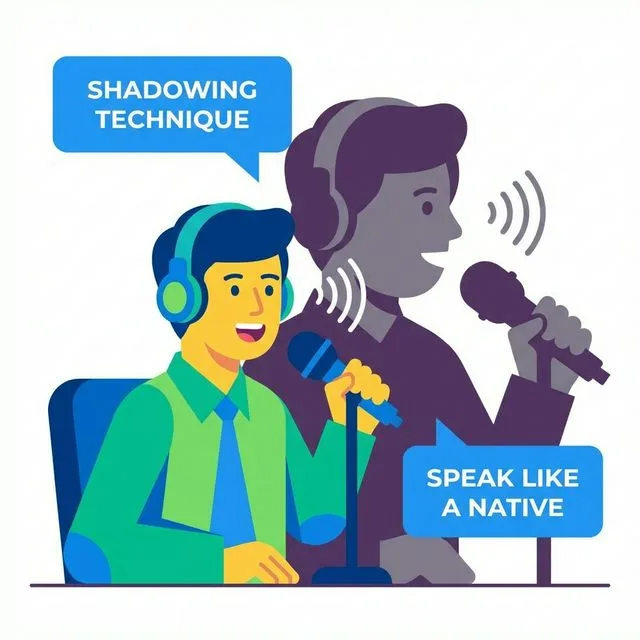
Active Shadowing: The Secret Polyglot Technique for Accent and Rhythm
You've been studying English for years, you know the vocabulary, and you've swallowed the grammar rules. But when you speak, do your sentences still sound a bit "artificial" or "robotic"?
Even if you pronounce individual words correctly, do you feel like you're missing that signature English flow and melody?
The problem is not your vocabulary; it is your speech rhythm. Unlike Turkish, which is a syllable-timed language, English is a stress-timed language. This means the rhythm of a sentence depends on the time between stressed words, not the total syllable count. The most effective way to master this rhythm is Shadowing—a favorite technique among polyglots.
1. What is Shadowing? Becoming the Sound's Shadow
Shadowing is the practice of mimicking an audio source (a podcast, a movie scene, or a speech) with almost zero delay (0.2 to 0.5 seconds later) as you hear it.
Just like a shadow follows a body, you copy the speaker's voice, stress patterns, pauses, and breathing intervals. The goal is not to read text, but to replicate the acoustic melody. This technique activates mirror neurons in the brain, rapidly accelerating motor language skills.
2. Why Passive Listening is Not Enough
Many learners expect their speaking to improve simply by watching TV shows or listening to music. This is passive learning. While passive input boosts comprehension (receptive skills), it does not train the physical vocal muscles (productive skills).
The muscles in your mouth (tongue, lips, jaw) have been trained for years to produce Turkish sounds. Creating English sounds like the "th", "w", or "r" requires a different muscle coordination. Shadowing is neuro-muscular gymnastics that retrains these vocal articulators.
3. A 4-Step Shadowing Workout
By practicing this technique for just 10-15 minutes a day, you will notice a significant shift in your conversational melody within a month:
Step A: Choose the Right Material
Select a short (1-2 minutes) audio clip that is slightly below your comprehension level. Ensure the speaker has the accent (American, British, etc.) you want to acquire. Audio passages on WordMaster are perfect for this.
Step B: Listen and Observe First
Listen to the clip normally 1-2 times. Pay attention to which words are stressed, where the speaker pauses to breathe, and how words are linked together.
Step C: Mimic with Text (Semi-Shadowing)
Play the audio and read along, repeating the words out loud just half a second behind the speaker. Recording your own voice helps you spot pronunciation mismatches.
Step D: Mimic without Text (True Shadowing)
Now, close the text. Rely solely on the sounds entering your ears. Mimic the speaker blindly, focusing purely on rhythm, stress, and intonation without worrying about parsing definitions. It’s like humming along to a song.
Final Thought: Language is a Melody
Remember, language is not just a mathematical structure of rules; it is a living melody. Use shadowing to teach your brain to hum this tune. You will find your accent softening and your sentences flowing with far less effort.
Download Vocabulary Guide For This Article
Download our custom-made printable PDF study sheet featuring all the essential vocabulary related to this topic.

Hakan Dağ
Founder & Language Architect
Software Engineer and English Instructor with 15+ years of experience in IT and education technology. Passionate about merging smart tools with genuine pedagogy.
Related Posts
Language Fossilization: Why You Have Been Making the Same Mistake for Years (and Nobody Told You)
'I am agree', 'discuss about', 'informations'... You have spoken English for years, you get understood, you may even run good meetings, yet a handful of errors seem carved in stone. Larry Selinker named it 'fossilization' in 1972: an interlanguage that stops growing exactly where communication stops demanding more. We look at why it happens, which errors tend to harden in Turkish speakers, and how 'noticing' can finally crack the shell.
Stephen Krashen's Affective Filter Hypothesis and the Neurobiology of Linguistic Freeze: How the Amygdala Shuts Down Adult Speech Production
Why do highly credentialed professionals who comprehend 95% of written English and possess rich vocabularies suddenly freeze the moment an impromptu question is directed at them in an international meeting? Drawing upon Stephen Krashen's foundational Second Language Acquisition (SLA) Monitor Model and contemporary cognitive neuroscience, we investigate the amygdala hijack behind linguistic paralysis, dismantle adult perfectionism, and present an actionable '80% Adequacy Protocol' to lower the affective filter permanently.
The Math of Understanding: The 98% Rule, Word Frequency, and Why the Right 3,000 Words Beat 10,000 Random Ones
Knowing 90% of the words in a text sounds great. In reality, it means one unknown word in every line, and it turns reading into a struggle. Using numbers and visuals, we explain the hidden threshold linguists call "coverage," what Zipf's law means for vocabulary learning, and how to choose your word list wisely.
💬 Discussion0
You must log in to comment.
Put Learning into Practice!
Improve your vocabulary with WordMaster, practice with an AI tutor.
Start for Free