The Hidden Micro-Nuance of Words: Navigating the 5 Degrees of Emotional Heat Between Look, Stare, Glare, and Gaze
Dictionaries flatten these distinct verbs into a generic 'to look', yet the intent, duration, and social hazard differ profoundly. Master the art of choosing the exact word without causing unintended offense.
Listen to Article (High-Definition Audio)
What Happens When You Tell Someone You "Stared" at Them in the Library?
Picture yourself in a quiet university library or an espresso bar in London. Across the room sits someone captivating. You catch yourself stealing glances every few minutes. Later that evening, recounting the moment to an English-speaking friend, you warmly proclaim: "I sat there and stared at her for an hour."
You might notice your friend slightly recoiling in shock. While in your mind you were painting a sweet, tender memory, the visual evoked in their mind is downright terrifying: an unblinking, predatory weirdo who invaded someone's personal boundary for sixty uninterrupted minutes.
This illustrates the single most insidious hurdle in language learning: micro-nuance blindness. Bilingual dictionaries routinely flatten Look, Glance, Gaze, Stare, and Glare into a generic verb: "to look". Yet the variance in emotional heat, intent, duration, and social hazard between these words is as vast as the distance between an intimate whisper and an aggressive shout.
1. The Cognitive Heat Spectrum: From 1 Second to Raw Hostility
To communicate with genuine fluency, words must be acquired through their "emotional temperature" and "social risk index." In English-speaking cultures, visual contact is considered a direct incursion into personal space, making your choice of verb consequential.
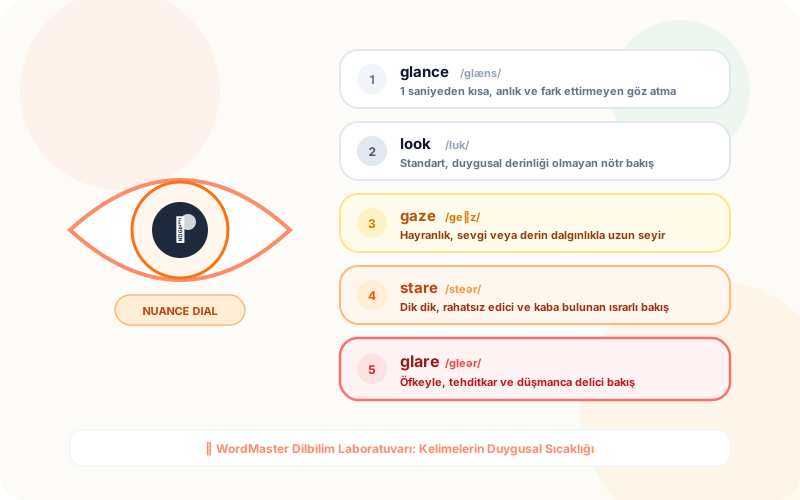
1. Glance (/ɡlæns/) — The Sub-Second Rule
Heat Index: 1/5 (Neutral / Covert) | Duration: < 1 second
A rapid, momentary swivel of sight that instantly withdraws before being caught. Used when checking a wristwatch or catching someone's silhouette discreetly. Completely devoid of menace.
Example: "She glanced at her watch during the awkward pause."
2. Look (/lʊk/) — The Neutral Umbrella Baseline
Heat Index: 2/5 (Pure Neutral) | Duration: 2-5 seconds
The raw mechanical act of aiming your eyes toward an object. It carries zero inherent sentiment—neither affection nor hostility. If you wish to convey atmosphere or mood, "look" alone falls flat.
Example: "Look at the diagram on page twenty-four."
3. Gaze (/ɡeɪz/) — Wonder, Admiration, and Poetic Reverie
Heat Index: 3/5 (Warm / Lyrical / Deep) | Duration: Prolonged & Dreamy
This was the exact word you needed for that library encounter. "Gaze" describes looking steadily at a breathtaking vista, a star-strewn sky, or a cherished person with quiet wonder and introspection. It never feels intrusive; it bestows dignity and fondness.
Example: "They sat on the terrace and gazed at the starry skyline."
4. Stare (/steər/) — The Social Faux Pas: Invasive Fixation
Heat Index: 4/5 (Intrusive / Impolite) | Duration: Prolonged & Unblinking
Locking eyes without regard for the other person's comfort. One of the earliest lessons drilled into Western children is: "Don't stare, it's rude!" Staring on a subway platform or across an office floor feels invasive and frequently provokes confrontation.
Example: "Stop staring at him; it makes people feel uncomfortable."
5. Glare (/ɡleər/) — Piercing with Hostile Daggers
Heat Index: 5/5 (Volcanic / Hostile) | Duration: Intense & Piercing
Narrowing your eyes and projecting raw fury directly at someone like a physical weapon. The glare is the classic look directed at a rival who broke protocol or a colleague who interrupted a presentation.
Example: "The manager glared at the employee who arrived forty minutes late."
2. Why Nuance Unlocks True Fluency
The defining divide between intermediate (B1-B2) and advanced (C1-C2) mastery is rarely vocabulary volume; it is mastery over connotation and emotional resonance.
Saying "I looked at him angrily" is grammatically spotless, but a native speaker captures that exact mood in a single heartbeat: "I glared at him." Precision is where conversational elegance begins.
💡 WordMaster Practice Tip:
Next time you watch a series or read an English novel, notice how authors describe action. Did they settle for "he looked", or did they write "he peered through the mist"? That single lexical choice breathes atmosphere into the entire narrative.
Learn words not as lifeless dictionary entries, but as vibrations of human psychology. Next time your eyes wander, ask yourself: Am I casting a glance, or lost in a gaze?
Download Vocabulary Guide For This Article
Download our custom-made printable PDF study sheet featuring all the essential vocabulary related to this topic.

Numan Kanar
ELT Instructor & Educational Author
Experienced English Language Teaching (ELT) instructor and educational author focusing on academic reading, vocabulary development and English proficiency examination preparation.
Related Posts
The Gravitational Pull of Words: Michael Hoey's Lexical Priming Theory and Why Isolated Word Memorization Fails
Why do even advanced language learners reflexively produce mechanical phrasing like 'make an agreement' or 'big problem' when native professionals intuitively generate 'reach a consensus' or 'pressing concern'? Grounded in Michael Hoey's corpus-driven Lexical Priming theory, we investigate how words exert multi-dimensional gravitational pull in the mental lexicon, dissolving the arbitrary dichotomy between grammar and vocabulary through four structural axes.
The Cognitive Blueprint of Phrasal Verbs: Stop Memorizing and Decode the Mental Maps of Particles (Up, Out, Off, Down)
Attempting to brute-force thousands of phrasal verbs from alphabetical vocabulary sheets flies in the face of human cognitive architecture. Rooted in George Lakoff and Mark Johnson's Conceptual Metaphor Theory, we demonstrate how spatial particles (Up, Down, Out, Off) form an intuitive mental compass—explaining why UP signals completion and emergence, OUT unlocks discovery, and OFF dictates detachment.
Decoding Words Without a Dictionary: Morpheme Stress, Productive Affixes, and the Double Life of -ing and -ed
You hit "unpredictable" in a news article. Do you reach for the dictionary, or does the word itself tell you something? English morphology isn't a historical accident — it's a working derivation system. From the stress rule in long words to the -er/-ee mirror, the two jobs of -ing, and Latin roots you already share with Turkish, here's how to solve a word instead of looking it up.
💬 Discussion0
You must log in to comment.
Put Learning into Practice!
Improve your vocabulary with WordMaster, practice with an AI tutor.
Start for Free