The Gravitational Pull of Words: Michael Hoey's Lexical Priming Theory and Why Isolated Word Memorization Fails
Why do even advanced language learners reflexively produce mechanical phrasing like 'make an agreement' or 'big problem' when native professionals intuitively generate 'reach a consensus' or 'pressing concern'? Grounded in Michael Hoey's corpus-driven Lexical Priming theory, we investigate how words exert multi-dimensional gravitational pull in the mental lexicon, dissolving the arbitrary dichotomy between grammar and vocabulary through four structural axes.
Listen to Article (High-Definition Audio)
The Glass Ceiling of Second-Language Fluency: Knowing the Word but Lacking the Natural Groove
There is a recurring and deeply frustrating milestone in the trajectory of ambitious adult English learners: you hold an advanced degree, your C1 or C2 credential from Cambridge or ETS is framed on your wall, and your passive vocabulary spans thousands of terms. Yet the moment you unmute in an international executive steering meeting, sentences emerge that feel uncomfortably mechanical:
"We need to make an agreement with the other company because we have a very big problem with our money."
Syntactically, the clause is unimpeachable: subject agreement is intact, tenses align, prepositions obey basic textbook rules. Yet moments later, a London or New York counterpart reformulates precisely the same operational reality with effortless economy:
"We need to reach an accord with our counterparty, given our pressing liquidity constraints."
The gulf separating these two utterances is neither raw intellectual horsepower nor the sheer quantity of flashcards conquered. It is an architectural difference in how lexical entries are housed within the brain. In the learner's mind, words sit like isolated dictionary entries on flat shelves. In the native speaker's mental lexicon, every word is a dense gravitational body surrounded by a multi-dimensional orbit.
The academic breakthrough that illuminated this phenomenon is known in corpus linguistics as Lexical Priming.
Michael Hoey's Paradigm Shift: Grammar and Vocabulary Are Not Separate Engines
For decades, institutional language pedagogy operated under a post-Chomskyan assumption: "The human brain possesses an innate grammar engine (the computational rules) and an independent mental lexicon (the storage bin). During speech production, the brain retrieves raw words from the bin and threads them through the grammar slots."
In 2005, the late British corpus linguist Prof. Michael Hoey dismantled this compartmentalized model with his seminal work, Lexical Priming: A New Theory of Words and Language. Analyzing billions of words across empirical digital corpora, Hoey established a radical truth:
"There is no autonomous, abstract grammar processor waiting for inert vocabulary. Every time we encounter, process, or utter a word, our neurocognitive system primes that word with the exact collocational companions, colligational syntactic slots, and affective atmospheres in which it was witnessed. The word carries its own grammar on its back."
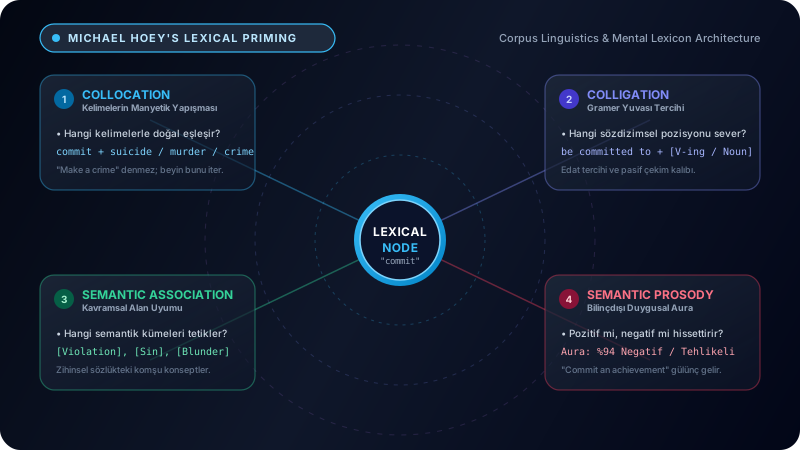
The Four Dimensions of a Word's Gravitational Field
A word memorized solely as an isolated translation equivalent is merely one-dimensional (1D). True pragmatic competence emerges when you reconstruct that word's four-dimensional priming vector:
1. Collocation (Lexical Magnetism)
The statistical probability of two independent lexical items co-occurring in natural text. While synonyms might share dictionary definitions, their collocational loyalty is exclusive. We say heavy rain or torrential downpour, but never strong rain. We speak of a profound impact, while deep impact evokes cinema rather than business analytics.
reach a consensus (✓) / make a consensus (✕) — take measures (✓) / do measures (✕)
2. Colligation (Syntactic Slot Preference)
The preference of a word for specific grammatical categories, morphological shapes, or syntactic configurations. For instance, the noun consequences overwhelmingly favors plural morphology and routinely nests in passive or negative predicate frames (face the consequences, reap the consequences).
3. Semantic Association (Conceptual Field Resonance)
The semantic domain that a word instinctively activates in the mental lexicon. The verb erupt is not primed exclusively for vulcanology; corpus data reveals that over 80% of its metaphorical deployments co-occur with terms of collective socio-political volatility: violence, riots, scandal, protests.
4. Semantic Prosody (The Subconscious Affective Aura)
Perhaps the most startling discovery in modern corpus analysis: words that appear entirely neutral in formal lexicography often harbor a 95% negative or positive emotional charge. The brain senses this aura before it finishes reading the sentence.
The verb "CAUSE" is primed negatively across 92% of corporate corpus data: cause disruption, cause injury, cause losses. Saying "you caused my promotion" sounds comically unnatural.
Forensic Case Study: The Hidden Aura of "Commit" and "Utterly"
Consider the transitive verb commit. It is often taught to learners under benign definitions like "to pledge, dedicate, or perform." Yet if an executive stands before an investor syndicate and proclaims, "Our development squad committed a magnificent achievement this quarter!", the audience experiences immediate cognitive friction.
Why? Because the core priming history of commit across centuries of usage is tied to transgressive, pathological, or felonious acts: commit suicide, commit murder, commit perjury, commit a blunder. Its semantic prosody is shadowed. Achievements are not committed; they are delivered, secured, or unlocked.
The identical principle governs the intensifier utterly. While dictionary glosses equate it to "completely" or "totally", empirical usage reveals that native discourse pairs utterly almost exclusively with devastation or absurdity: utterly exhausted, utterly ridiculous, utterly hopeless, utterly ruined. To declare yourself "utterly delighted" is acceptable only as playful, intentional irony.
How to Upgrade from 1D Word Cards to 4D Lexical Gravitational Networks
If you wish to purge the unnatural rigidity from your professional English, restructure your vocabulary acquisition protocol along three actionable axes:
-
Never Capture Words in Solitary Confinement (The Rule of Three): When acquiring new vocabulary, never write an isolated lemma. Anchor the word in its dominant verb + noun or adjective + noun pairing. If you discover discrepancy, do not record "discrepancy = fark". Record "reconcile an apparent discrepancy".
-
Consult Corpus Frequencies over Translation Apps: When drafting high-stakes correspondence, verify your intuition using corpus engines like the British National Corpus, COCA, or Ludwig.guru. Observe whether native professionals gravitate toward "make an agreement" or "forge a consensus".
-
Listen for Priming Magnetism During Immersion: When listening to executive podcasts, quarterly investor calls, or legal debates, shift your focus from overall comprehension to collocational affinity. When you hear "stark contrast" or "glaring oversight", make a mental note: these words are natural gravitational partners.
Ultimately, when two professionals possess an identical raw vocabulary count, the speaker who commands the room with effortless fluency is not the one who knows more grammar rules. It is the one whose mental lexicon organizes words into rich, magnetic clusters that effortlessly draw each other into speech.
Download Vocabulary Guide For This Article
Download our custom-made printable PDF study sheet featuring all the essential vocabulary related to this topic.

Hakan Dağ
Founder & Language Architect
Software Engineer and English Instructor with 15+ years of experience in IT and education technology. Passionate about merging smart tools with genuine pedagogy.
Related Posts
The Cognitive Blueprint of Phrasal Verbs: Stop Memorizing and Decode the Mental Maps of Particles (Up, Out, Off, Down)
Attempting to brute-force thousands of phrasal verbs from alphabetical vocabulary sheets flies in the face of human cognitive architecture. Rooted in George Lakoff and Mark Johnson's Conceptual Metaphor Theory, we demonstrate how spatial particles (Up, Down, Out, Off) form an intuitive mental compass—explaining why UP signals completion and emergence, OUT unlocks discovery, and OFF dictates detachment.
Decoding Words Without a Dictionary: Morpheme Stress, Productive Affixes, and the Double Life of -ing and -ed
You hit "unpredictable" in a news article. Do you reach for the dictionary, or does the word itself tell you something? English morphology isn't a historical accident — it's a working derivation system. From the stress rule in long words to the -er/-ee mirror, the two jobs of -ing, and Latin roots you already share with Turkish, here's how to solve a word instead of looking it up.
Start or Commence? The Two-Storey House of English Vocabulary and Why Latin Words Can Make You Sound Cold
English has two words for almost everything: one from the kitchen, one from the palace. "Help" and "assist," "buy" and "purchase," "cow" and "beef." We explore how the Norman Conquest of 1066 still shapes the tone of your emails today, and why Turkish speakers keep choosing the upstairs words without realizing it.
💬 Discussion0
You must log in to comment.
Put Learning into Practice!
Improve your vocabulary with WordMaster, practice with an AI tutor.
Start for Free