Animal Idioms in English: The Most Colorful Metaphors That Describe Character
How would you feel if someone called you an 'eager beaver' or a 'black sheep'? Discover English's most charming and colorful animal idioms, and explore how they differ across cultures.
Listen to Article (High-Definition Audio)
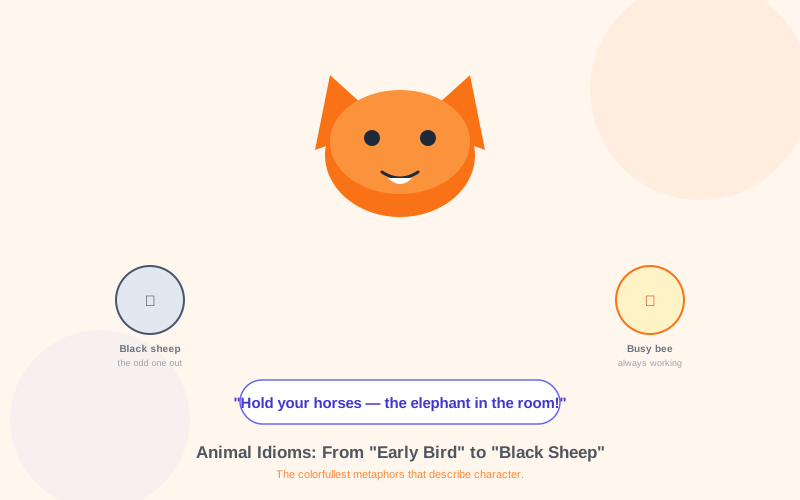
Making People Laugh with a Single Animal
In a meeting, someone says about the new intern: "She's a real eager beaver." Translate it word for word and you end up confused: "eager beaver"? In fact, calling someone an "eager beaver" in English is a charming way of saying they're enthusiastic, hard-working, and full of energy. And honestly, beavers do work hard, so fair enough!
This is one of the most fun and colorful corners of English: animals. We use animal metaphors to describe people, situations, and behaviors — and many of them don't translate directly into other languages. That's because every culture assigns a different personality to each animal. A Turk's "eşek" and an Englishman's "donkey" might not even be the same guy!
1. Animal Idioms That Describe Character
In both business and social life, animal metaphors are one of the most natural ways to describe someone. Here are the most common ones:
- Eager beaver: Someone enthusiastic and hard-working. "The eager beaver finished the report before anyone asked."
- Early bird / Night owl: An early riser / someone who stays up late. "I'm a night owl, I do my best work at midnight."
- Social butterfly: Someone who thrives in crowds and connects with everyone. "At parties you'll find her everywhere — she's such a social butterfly."
- Lone wolf: Someone who prefers to work alone. "He's a bit of a lone wolf, doesn't like teamwork much."
- Busy bee: Someone always occupied. "My grandmother is a busy bee, always baking or gardening."
- Black sheep: The odd one out of a family or group. "He's the black sheep of the family."
- Chicken: A coward. "Don't be such a chicken!"
- A mouse: A quiet, timid person. "She's as quiet as a mouse."
Notice how some idioms change completely across cultures. For example, in Turkish, stubborn people are compared to a donkey ("eşek"), while in English the stubborn animal is the mule — stubborn as a mule. Same trait, different animals carrying the load.
2. Animal Idioms That Describe Situations
Animals describe not just people but events too. Here's a handful of classics you'll hear often:
- Let the cat out of the bag: To reveal a secret. "Who let the cat out of the bag about the surprise party?"
- Curiosity killed the cat: Being too nosy can get you into trouble. "Curiosity killed the cat — maybe don't ask about that."
- Hold your horses: Don't rush. "Hold your horses, we'll be there in five minutes!"
- Straight from the horse's mouth: From the most reliable, first-hand source. "I heard it straight from the horse's mouth."
- When pigs fly: A humorous way to say "never". "He'll apologize when pigs fly!"
- The elephant in the room: The big issue everyone knows about but nobody mentions. "We should really address the elephant in the room."
- Take the bull by the horns: To face a difficult situation bravely. "She took the bull by the horns and confronted the issue."
- A wild goose chase: A pointless, exhausting search. "Looking for that lost file turned into a wild goose chase."
3. Why Do Some Idioms Differ Across Cultures?
The animal a culture chooses for an idiom usually reflects that animal's role in its daily life. In Turkey, because the donkey has long been part of everyday life, it became the symbol of stubbornness. In England, that stubbornness belongs to the mule. When it comes to cats, the world mostly agrees: they're curious and agile, but they don't keep secrets!
Learning these differences means understanding not just vocabulary, but a whole culture. When you wonder why a community chose a certain animal, you start to glimpse its everyday life. That turns language learning from memorization into a journey of discovery.
4. Four Tips to Remember These Idioms
- Picture the metaphor: When you hear "hold your horses", imagine the horses standing there waiting. Visual memory is far stronger than abstract meaning.
- Match them to your own language: "Black sheep" = kara koyun, "straight from the horse's mouth" = atın ağzından. Write down the differences.
- Hear them in real context: Catching an idiom in a scene or a podcast plants it more firmly in your memory.
- Choose just three a week: Instead of memorizing dozens, use three out loud every day for a week.
5. Try Them in Your Next Conversation
Animal idioms bring life to your speech and make native speakers think, "This person really lives the language." Imagine dropping "the elephant in the room" smoothly in your next meeting — the moment you do, you'll spot a familiar spark in the other person's eyes.
💡 WordMaster Tip:
Animal idioms appear often in WordMaster's Daily Words and idiom-focused content. When you meet an idiom, take a moment to look up the cultural story behind it; that single sentence will stick with you longer than a week of memorizing.
Learning a language often feels like serious work, but the best moments come when you unlock the little cultural secret behind an idiom. Animals are the oldest and most endearing way humans have told stories about humanity. So don't be shy about adding a couple of animals to your conversations — whether you're a "busy bee" or a "night owl", it doesn't matter. What matters is that your words are alive.
Download Vocabulary Guide For This Article
Download our custom-made printable PDF study sheet featuring all the essential vocabulary related to this topic.

Elspeth Tavaci
ELT Author, Editor & Educational Writer
Experienced English Language Teaching (ELT) author, editor and educational writer with a strong background in developing engaging learning materials for children and young learners.
Related Posts
The Gravitational Pull of Words: Michael Hoey's Lexical Priming Theory and Why Isolated Word Memorization Fails
Why do even advanced language learners reflexively produce mechanical phrasing like 'make an agreement' or 'big problem' when native professionals intuitively generate 'reach a consensus' or 'pressing concern'? Grounded in Michael Hoey's corpus-driven Lexical Priming theory, we investigate how words exert multi-dimensional gravitational pull in the mental lexicon, dissolving the arbitrary dichotomy between grammar and vocabulary through four structural axes.
The Cognitive Blueprint of Phrasal Verbs: Stop Memorizing and Decode the Mental Maps of Particles (Up, Out, Off, Down)
Attempting to brute-force thousands of phrasal verbs from alphabetical vocabulary sheets flies in the face of human cognitive architecture. Rooted in George Lakoff and Mark Johnson's Conceptual Metaphor Theory, we demonstrate how spatial particles (Up, Down, Out, Off) form an intuitive mental compass—explaining why UP signals completion and emergence, OUT unlocks discovery, and OFF dictates detachment.
Decoding Words Without a Dictionary: Morpheme Stress, Productive Affixes, and the Double Life of -ing and -ed
You hit "unpredictable" in a news article. Do you reach for the dictionary, or does the word itself tell you something? English morphology isn't a historical accident — it's a working derivation system. From the stress rule in long words to the -er/-ee mirror, the two jobs of -ing, and Latin roots you already share with Turkish, here's how to solve a word instead of looking it up.
💬 Discussion0
You must log in to comment.
Put Learning into Practice!
Improve your vocabulary with WordMaster, practice with an AI tutor.
Start for Free