English by Rule of Thumb: How 'Vague Language' and Approximations Make You Sound 10x More Natural
Textbooks teach rigid precision, but real people speak in approximations, soft estimates, and fuzzy boundaries. Learn how 'vague language' transforms stiff English into natural, conversational fluency.
Listen to Article (High-Definition Audio)
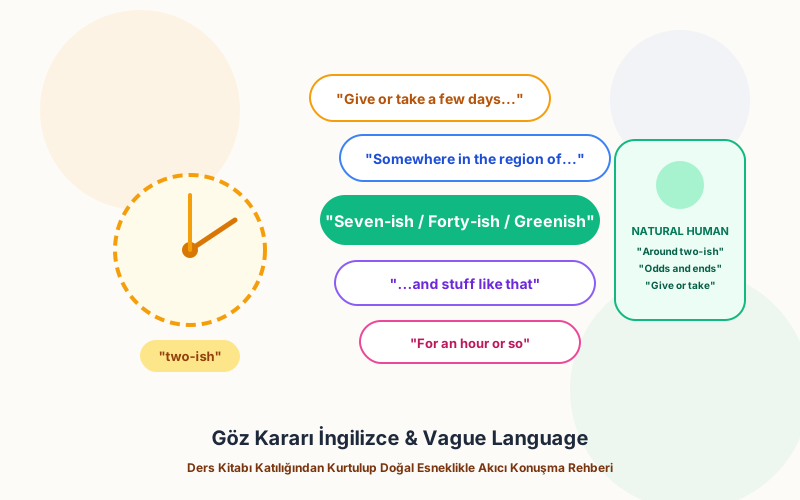
Speaking Like a Human, Not an Algorithm
Let's run a quick thought experiment. You're letting a friend know what time you'll meet tomorrow. Which option sounds like a real person?
- Option A: "I will arrive at the restaurant at precisely 14:00 and we shall consume food for 45 minutes."
- Option B: "I'll be there two-ish, and we can grab a bite or something."
Option B wins every single time! Option A is grammatically flawless, yet it sounds less like a friend and more like a robotic police transcript. In linguistics, this relaxed conversational phenomenon is known as Vague Language and Approximations.
One of the most persistent misconceptions among language learners is the belief that every sentence must carry razor-sharp precision. In reality, native speakers deliberately use soft estimates and fuzzy qualifiers to sound approachable, tactful, and socially fluid.
1. The Magic Suffix: The Wonder of '-ish'
One of the most versatile and charming grammatical wildcards in English is the suffix "-ish". You can attach it to almost any word to imply "around", "kind of", or "roughly":
- With Time: "Let's meet at seven-ish." (Around seven o'clock.)
- With Age: "He was forty-ish, wearing a dark coat." (Around forty years old.)
- With Colors: "It's a greenish-blue jacket." (A hue leaning towards green and blue.)
- With Moods & States: "Are you hungry? — Hungry-ish, I could eat a snack." (Somewhat hungry, but not starving.)
This single syllable instantly breathes casual authenticity into your speech.
2. Softening Numbers, Durations, and Costs
When you don't possess the exact figure down to the last decimal, lean into these polished approximations:
1. "Give or take..." (Plus or minus a small margin)
"It will take about twenty minutes, give or take."
2. "Somewhere in the region of..." / "In the ballpark of..."
"The project will cost somewhere in the region of ten thousand dollars."
3. "...or so" (Approximately that duration or amount)
"We stayed there for an hour or so."
4. "Roughly speaking..." / "More or less..."
"Roughly speaking, half the team works remotely."
3. Everyday Fuzzy Objects: "Stuff Like That"
While "etcetera" (etc.) is perfectly fine in an academic paper, saying "etcetera" aloud in casual conversation sounds stiff and pedantic. Natural speakers use conversational round-offs instead:
- "...and stuff like that" / "...and things like that": "We talked about movies, music, and stuff like that."
- "Odds and ends": Small, miscellaneous tasks or items. "I just need to finish a few odds and ends before leaving."
- "Whatshisname" / "Whatsit": Placeholders when a name temporarily slips your mind. "Pass me that... whatsit over there."
4. Why Vague Language Is Actually a Social Courtesy
Applied linguistics research from Cambridge highlights that overly absolute phrasing in English ("You must do this at 10:00 sharp") can sound demanding or blunt. By saying "Could we sort this out sometime around ten-ish?", you grant your listener polite psychological flexibility. Vague language is not laziness; it is the lubricant of human politeness and empathy.
💡 WordMaster Transformation Drill:
Stiff: "I am 30 years old and I like cars, books, and other objects."
Natural: "I'm thirty-ish, into cars, reading, and that sort of thing."
Treat language not as a rigid metal ruler, but as an adaptable human bridge. Sprinkle a bit of '-ish' and a dash of 'give or take' into your sentences. As your words soften, your conversational ease will soar.
Download Vocabulary Guide For This Article
Download our custom-made printable PDF study sheet featuring all the essential vocabulary related to this topic.

Hakan Dağ
Founder & Language Architect
Software Engineer and English Instructor with 15+ years of experience in IT and education technology. Passionate about merging smart tools with genuine pedagogy.
Related Posts
The Gravitational Pull of Words: Michael Hoey's Lexical Priming Theory and Why Isolated Word Memorization Fails
Why do even advanced language learners reflexively produce mechanical phrasing like 'make an agreement' or 'big problem' when native professionals intuitively generate 'reach a consensus' or 'pressing concern'? Grounded in Michael Hoey's corpus-driven Lexical Priming theory, we investigate how words exert multi-dimensional gravitational pull in the mental lexicon, dissolving the arbitrary dichotomy between grammar and vocabulary through four structural axes.
The Cognitive Blueprint of Phrasal Verbs: Stop Memorizing and Decode the Mental Maps of Particles (Up, Out, Off, Down)
Attempting to brute-force thousands of phrasal verbs from alphabetical vocabulary sheets flies in the face of human cognitive architecture. Rooted in George Lakoff and Mark Johnson's Conceptual Metaphor Theory, we demonstrate how spatial particles (Up, Down, Out, Off) form an intuitive mental compass—explaining why UP signals completion and emergence, OUT unlocks discovery, and OFF dictates detachment.
Decoding Words Without a Dictionary: Morpheme Stress, Productive Affixes, and the Double Life of -ing and -ed
You hit "unpredictable" in a news article. Do you reach for the dictionary, or does the word itself tell you something? English morphology isn't a historical accident — it's a working derivation system. From the stress rule in long words to the -er/-ee mirror, the two jobs of -ing, and Latin roots you already share with Turkish, here's how to solve a word instead of looking it up.
💬 Discussion0
You must log in to comment.
Put Learning into Practice!
Improve your vocabulary with WordMaster, practice with an AI tutor.
Start for Free