Why Does Your Brain Get Exhausted Watching Movies Without Subtitles? The Auditory Compression Reality
You understand everything with subtitles, but turn them off and your brain melts after 15 minutes? Discover auditory neurology, connected speech compression, and actionable ear endurance hacks.
Listen to Article (High-Definition Audio)
Why Does Your Brain Get Exhausted Watching Movies Without Subtitles? The Auditory Compression Reality
You have almost certainly experienced this exact scenario:
You open Netflix with total confidence; "Today, I am turning off English subtitles!" For the first 3 minutes, the main character enters a coffee shop and says, "Can I get a black coffee?" You smile to yourself; "Oh great, I can understand this!"
However, by minute 12, two characters begin an intense argument. Sentences blur together, sounds get swallowed, and suddenly a massive wall of acoustic noise crashes into your ears. By minute 20, you feel a dull tension behind your temples, your brain feels completely melted, and your hand reluctantly reaches for the remote: Turn Subtitles On (English).
You get frustrated with yourself: "I've been studying for years, I have a strong vocabulary, I'm C1 level... why can't I last 20 minutes without subtitles?!"
Let me reassure you immediately: This is not a lack of intelligence or capability. It is purely a neurological reality of human auditory processing and the linguistic nature of Phonetic Compression in natural English.
Let's unpack this from both a brain science and linguistic perspective over a warm, friendly chat.
---
1. Your Eyes Are Making Your Ears "Lazy": Visual Dominance
For years, in traditional classrooms and apps, we learned English through our eyes. We read words in dictionaries, scanned textbook pages, and read subtitles on screens.
When you turn on English subtitles, your brain executes a brilliant shortcut: The visual cortex processes information up to 10 times faster than the auditory cortex. As your ears struggle to decode complex acoustic signals, your eyes read the text on screen in milliseconds, and your brain falsely claims: "See? I heard that!" In reality, you didn't hear it — you read it!
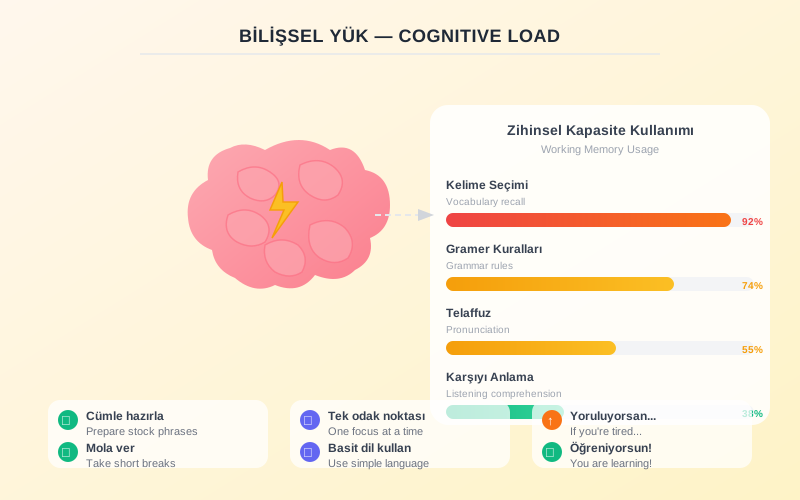
The moment you turn subtitles off, that massive visual safety net vanishes. Your auditory center is suddenly left completely unassisted, firing 5 times as many neurons to decode a single stream of sound. That intense cognitive strain is why your brain feels exhausted after just 15 minutes.
---
2. Written English and Spoken English Are Two Completely Different Languages
Textbook English teaches us clean, isolated words:
"What do you want to do this evening?"
Every word has clear boundaries and neat pauses. But a native speaker in a movie or on the street will almost never pronounce it like that. What actually leaves their mouth is:
"Whaddya wanna do thisevnin?"
In linguistics, this phenomenon is called Connected Speech and Phonetic Compression. Native speakers use three primary acoustic shortcuts for natural efficiency:
While your brain is searching its mental dictionary for 7 individual words ("What do you want to do"), your ears receive one continuous acoustic block: "Whaddyawanna". Because your brain can't find that exact block in its vocabulary database, it temporarily freezes.
---
3. Four Human Ways to Build Auditory Endurance
How do we overcome this listening fatigue and liberate our ears from subtitle dependency? Here is a practical roadmap:
💡 A. The 15-Minute Rule (Sprint Training)
Trying to watch a full 2-hour movie without subtitles is like running a marathon without training. Instead of straining for 90 minutes, do 15-minute ear workouts. Watch without subtitles for 15 minutes, then turn them back on guilt-free when tired. Over weeks, you will notice your endurance naturally extending to 20, 30, and 45 minutes.
💡 B. "Micro-Shadowing" Technique
Pick a 30-second scene from your favorite TV show. Listen without subtitles first. Then turn subtitles on and observe how the actor connected the sounds (e.g., noting "Loo-ka-thim" instead of "Look at him"). Mimic that compressed sound aloud in real-time. Once your mouth acquires the muscle memory, your ears will instantly recognize it.
💡 C. Slowed-Down Podcast Listening
Download an English podcast on Spotify or Apple Podcasts. Set the playback speed to 0.8x or 0.9x. Hearing native speech connections in slightly slower motion gives your brain's decoding engine space to process acoustic boundaries cleanly.
💡 D. Catch "Meaning Islands", Not Every Word
Don't panic over single missed words. Native speakers don't hear 100% of every phoneme either; they fill gaps using context. Focus on key nouns and verbs, and allow your subconscious mind to infer the connective tissue.
---
Final Thoughts: Be Gentle With Yourself
Remember how you learned your native language as a child — you didn't analyze grammar rules while watching cartoons. The human ear is an organic organ that thrives on exposure without pressure.
That sensation of mental fatigue when turning off subtitles isn't proof of failure; it is concrete evidence that your brain is building brand new neural pathways. Set the remote down, relax your shoulders, and trust the rhythm of the sounds!
Download Vocabulary Guide For This Article
Download our custom-made printable PDF study sheet featuring all the essential vocabulary related to this topic.

Hakan Dağ
Founder & Language Architect
Software Engineer and English Instructor with 15+ years of experience in IT and education technology. Passionate about merging smart tools with genuine pedagogy.
Related Posts
The Linguistic Fog: Why Non-Native Professionals Overuse Heavy Jargon to Mask Uncertainty
Why do non-native speakers struggling with impostor syndrome gravitate toward 'utilize' instead of 'use', or 'commence' instead of 'start'? Explore the psychology of linguistic fog, George Orwell's rules for muscular prose, and the authentic power of radical clarity.
The Intonation Traps of Turkish Speakers: Why Monotone Cadence Diminishes Your Charisma
Turkish is a syllable-timed language, while English is stress-timed. Why does giving equal duration to every syllable make native listeners perceive you as flat, robotic, or detached? Discover the acoustic power of the schwa (/ə/) and tonic pitch glide.
Global Accent Diversity & Neural Listening: 5 Psycholinguistic Ways to Master Accents
A comprehensive guide to decoding British RP, General American, and Aussie accent pitch shifts and adapting your auditory memory.
💬 Discussion0
You must log in to comment.
Put Learning into Practice!
Improve your vocabulary with WordMaster, practice with an AI tutor.
Start for Free