The Intonation Traps of Turkish Speakers: Why Monotone Cadence Diminishes Your Charisma
Turkish is a syllable-timed language, while English is stress-timed. Why does giving equal duration to every syllable make native listeners perceive you as flat, robotic, or detached? Discover the acoustic power of the schwa (/ə/) and tonic pitch glide.
Listen to Article (High-Definition Audio)
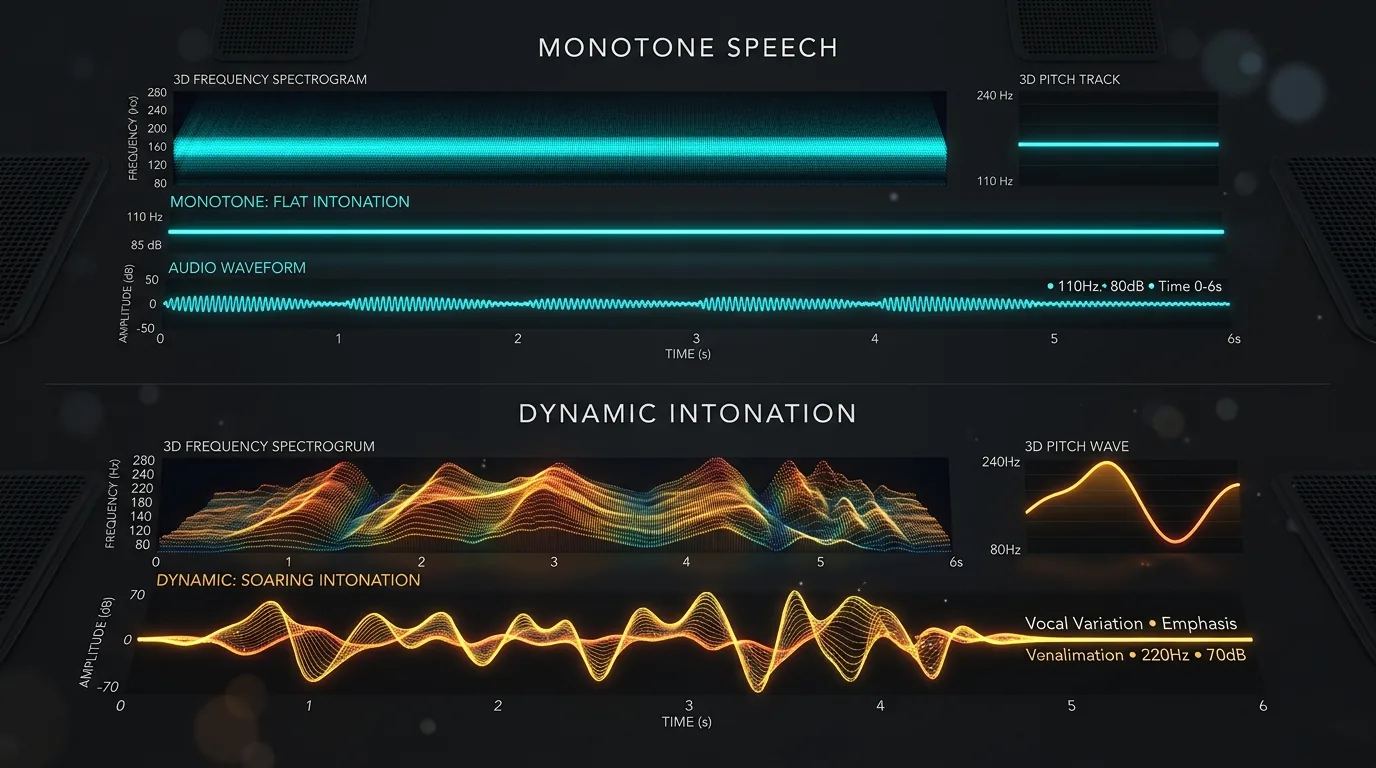
The Acoustic Clash: Metronomic Syllables vs. The Dictatorship of Stress
You may boast a C1 CEFR certificate, command thousands of sophisticated academic terms, and execute flawless grammatical syntax. Yet in cross-border executive meetings, do you frequently observe international colleagues gradually drifting off, breaking eye contact, or subconsciously judging your delivery as flat, emotionally distant, or lacking conviction?
This is not a deficit in intellect, vocabulary, or confidence; it is an unrecognized phonological cadence collision.
Turkish belongs to the family of Syllable-timed languages. In Turkish, every syllable receives roughly equivalent duration, volume, and acoustic real estate: pronouncing "Ge-le-cek-ler-di" functions like a mechanical metronome, granting equal milliseconds to each segment. English, by stark contrast, is strictly Stress-timed. The temporal intervals between stressed beats remain constant; all unstressed functional syllables in between are brutally compressed, reduced, and collapsed into micro-durations.
🇹🇷 Turkish: Syllable-Timed (The Metronome)
Every syllable is cleanly articulated with full vocalic value. Pitch contours remain relatively horizontal without radical spikes.
da - da - da - da - da (Equal Beats)
🇬🇧 🇺🇸 English: Stress-Timed (Syncopated Jazz)
Content words expand with dynamic pitch glides, while structural pronouns and prepositions collapse into the schwa (/ə/).
DAAA ... di-di ... DAAA ... di ... DAAA (Dynamic Wave)
1. The Schwa (/ə/): The Secret Engine of English Fluency
When a Turkish speaker utters "I want to go to the supermarket," they typically articulate each lexical unit with full phonetic weight: "Ay vant tu go tu dı supırmarket". To a native English ear, this sounds like a monotonous, mechanical typewriter clatter.
A native speaker, however, deliberately starves the grammatical function words of energy:
I want to go to the supermarket.
/aɪ ˈwɒnt tə ˈɡoʊ tə ðə ˈsuːpərmɑːrkɪt/
Notice how the preposition "to" is completely degraded into the lazy, central neutral vowel /tə/. Acoustic energy is reserved exclusively for three anchors: WANT, GO, SUPERMARKET.
2. The Tonic Syllable and Dynamic Pitch Gliding
Turkish conversational intonation operates within a relatively tight vocal frequency band. When this narrow acoustic contour is imported into English (Monotone Cadence), native listeners' mirror neurons register disinterest, apathy, or lack of conviction.
To project unmistakable authority, isolate the Tonic Syllable—the nuclear core of your thought—and launch your vocal pitch upward like a musical glide:
| Flat Monotone (L1 Transfer) | Dynamic Tonic Pitch Glide | Executive Impact |
|---|---|---|
| This is a great opportunity for us. (Flat horizon) | This is a GREAT opportunity for us. | Pitch ascends half an octave on "GREAT", then drops at the period. Signals authentic visionary drive. |
| We cannot accept this proposal. | We CANNOT accept this proposal. | Ironclad negotiation boundary with zero ambiguity. |
Stop obsessing over individual consonant perfection. In your next presentation, embrace the rhythm of jazz: crush the functional prepositions into the schwa, elevate your tonic syllables with unapologetic melodic height, and drop your cadence at the period. Your vocal presence will instantly transform.
Download Vocabulary Guide For This Article
Download our custom-made printable PDF study sheet featuring all the essential vocabulary related to this topic.

Hakan Dağ
Founder & Language Architect
Software Engineer and English Instructor with 15+ years of experience in IT and education technology. Passionate about merging smart tools with genuine pedagogy.
Related Posts
The Linguistic Fog: Why Non-Native Professionals Overuse Heavy Jargon to Mask Uncertainty
Why do non-native speakers struggling with impostor syndrome gravitate toward 'utilize' instead of 'use', or 'commence' instead of 'start'? Explore the psychology of linguistic fog, George Orwell's rules for muscular prose, and the authentic power of radical clarity.
Global Accent Diversity & Neural Listening: 5 Psycholinguistic Ways to Master Accents
A comprehensive guide to decoding British RP, General American, and Aussie accent pitch shifts and adapting your auditory memory.
Why Does Your Brain Get Exhausted Watching Movies Without Subtitles? The Auditory Compression Reality
You understand everything with subtitles, but turn them off and your brain melts after 15 minutes? Discover auditory neurology, connected speech compression, and actionable ear endurance hacks.
💬 Discussion0
You must log in to comment.
Put Learning into Practice!
Improve your vocabulary with WordMaster, practice with an AI tutor.
Start for Free