The Politeness Armor: How to Disagree Diplomatically in English Without Burning Bridges (Hedging & Softening)
Why does the room freeze when someone bluntly says 'You are wrong' in an international meeting? Master the art of diplomatic softening (hedging) to stand your ground with elegance, tact, and authority.
Listen to Article (High-Definition Audio)
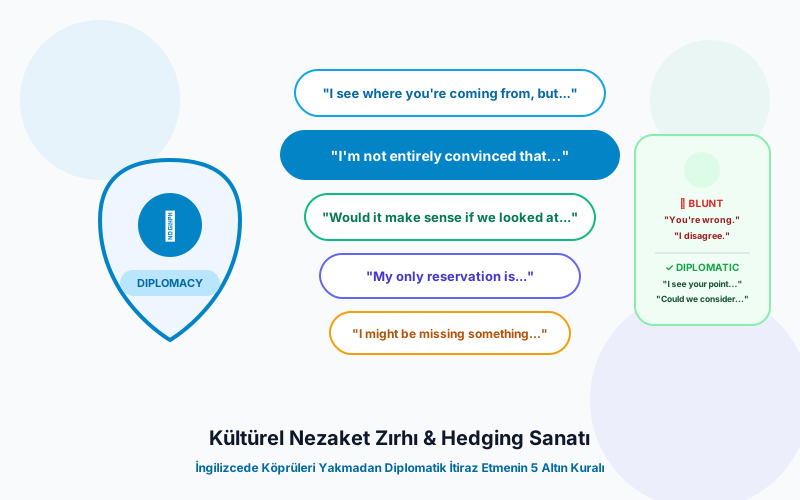
The Invisible Wall in the Boardroom
Picture a scenario all too common in global business: You're in an international project sync. A colleague presents an idea you know won't work. In your native culture, stating plainly "This is wrong, it won't work" might be respected as directness and honesty. But in global English, the moment you say "You are wrong, this won't work", the room turns icy, your colleague becomes defensive, and collaboration shuts down.
Why? Is your colleague fragile? No. The issue isn't what you said — it's how you packaged it. In Anglo-Saxon and international professional culture, blunt confrontation is perceived as abrasive and aggressive. Skilled leaders and diplomats champion their ideas vigorously, but they always do so wearing the armor of Hedging and Diplomatic Softening.
1. What Is 'Hedging' and Why Is It Not Weakness?
A frequent myth among learners is that diplomatic language signals hesitation or weakness. Nothing could be further from the truth! In English, hedging is the ultimate mark of executive poise: it rounds off sharp edges to protect the listener's dignity while making your argument far more persuasive and objective.
Instead of slamming down a wall of "No", you build a bridge of "Let's explore this together".
2. The 5-Step Diplomatic Disagreement Blueprint
Step 1: Validate Before You Pivot (The Cushion)
Acknowledge their perspective before introducing friction:
- "I see exactly where you're coming from..."
- "That's certainly an interesting perspective..."
- "I appreciate you bringing that to the table..."
Step 2: Frame Doubts Subjectively (Diplomatic Distance)
Replace accusatory 'You' statements with humble 'I' observations:
- "I'm not entirely convinced that..."
- "My only slight reservation is..."
- "I might be missing something here, but..."
Step 3: Pivot the Disagreement into an Inquiry
Invite them into the solution rather than dictating it:
- "Would it be worth considering..."
- "What if we looked at it from another angle?"
- "How would you feel about running a small pilot first?"
3. High-Risk Phrases vs. Executive Alternatives
Keep this transformation table handy for your next high-stakes presentation:
| ❌ Blunt / Confrontational | ✓ Diplomatic / Poised Alternative |
|---|---|
| "You don't understand." | "Perhaps I haven't explained myself clearly." |
| "That's impossible." | "That might prove quite challenging under our current timeline." |
| "I disagree with this plan." | "I have a few reservations regarding the implementation phase." |
| "Your numbers are wrong." | "Could we double-check the figures on slide four just to be safe?" |
4. The Silent Magic of Vocal Cadence
Delivering these phrases without sarcasm or rushing is paramount. Pair them with a calm smile and an open posture, and your counterpart will immediately recognize that you are working toward collective success rather than competing for dominance.
💡 WordMaster Career Insight:
Watch interviews of top diplomats; they virtually never utter 'No, you are wrong'. They guide the room with "That's one way to look at it, however...". True authority does not lie in volume; it lies in precision and tactical empathy.
True professionalism isn't about avoiding disagreement — it's about mastering the art of disagreeing without disconnecting. Next time you encounter a conflicting idea, try opening with "I see your point, though I wonder if..." and watch how quickly respect and rapport follow.
Download Vocabulary Guide For This Article
Download our custom-made printable PDF study sheet featuring all the essential vocabulary related to this topic.

Hakan Dağ
Founder & Language Architect
Software Engineer and English Instructor with 15+ years of experience in IT and education technology. Passionate about merging smart tools with genuine pedagogy.
Related Posts
The Art of Hedging in English: How to Sound Diplomatically Unassailable Without Weakening Your Authority
Saying "This marketing campaign is completely wrong" in an executive board meeting doesn't project strength—it broadcasts rigidity and vulnerability. Drawing on Ken Hyland and George Yule's epistemic framing framework, we analyze professional hedging strategies that anchor arguments in verifiable evidence rather than dogmatic assertion, narrowing rebuttal vectors while balancing strategic nuance against timid self-doubt.
Indirect Refusal and Pragmatic Repair in English: What "I'll See What I Can Do" Really Means
When an Anglo-American counterpart says "That's certainly an interesting angle, let me see what I can do," thinking they've accepted your proposal might be a costly pragmatic blunder. Drawing on Brown & Levinson's Politeness Theory, we deconstruct the 4-layer architecture of indirect refusal in corporate English, decode covert "soft no" signals, and master face-saving diplomatic counters.
The Art of Conversational Floor Control: How to Interrupt Elegantly and Hold Your Ground in Global Meetings
If you wait for a polite silence to take your turn in an English business meeting, that moment may never arrive. In Anglo-Saxon communication, conversational gaps aren't waited for—they are carved out. From Deborah Tannen's conversational overlap theory to elegant floor-holding tactics, learn to navigate global meeting dynamics with unshakeable authority.
💬 Discussion0
You must log in to comment.
Put Learning into Practice!
Improve your vocabulary with WordMaster, practice with an AI tutor.
Start for Free