"Like, You Know, Kind of..." — The Speaking Skill Nobody Teaches You
Listen carefully to a native English speaker and you'll notice: there are no perfectly clean sentences. "Like," "I mean," "sort of," "basically" are everywhere. This isn't sloppiness — it's a skill.
Listen to Article (High-Definition Audio)
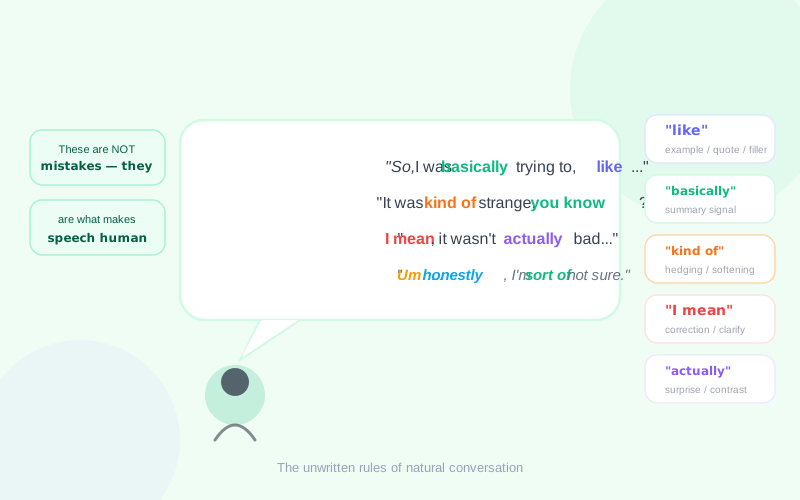
When you were learning English, someone probably told you: "Avoid saying um, uh, like — those are mistakes." Then you open a real podcast, listen to a real conversation, and you hear them everywhere. That's not a contradiction. That's a sign you were taught half the picture.
Filler words and hedging language are inseparable from natural speech. Without them, you can understand people — but you'll never fully sound like one. And native speakers notice the absence, even if they rarely say so.
🎙️ Why Filler Words Exist
First, a reframe: filler words are not a sign of low intelligence. Research actually shows that people with higher IQ scores tend to use more filler words — because they're processing more connections, thinking while they speak, revising in real time. These aren't verbal garbage. They do actual work:
- Buying thinking time — "Um, well..." signals to your brain and your listener: "I'm still constructing this, hold on."
- Social lubrication — "You know what I mean?" builds connection. It says: "I trust you to follow me."
- Maintaining conversational flow — Silence can feel heavier than a filler; sometimes a small sound keeps the exchange alive.
💬 The Most Common Fillers and What They Actually Do
Um / Uh
Thinking pauses. "Um" tends to signal a longer search; "uh" a shorter one. Used too often they become distracting, but used never, speech sounds scripted and tense.
Like
English's most famous filler — but it has four distinct uses, not one:
- Introducing an example: "She's really talented, like she can play three instruments."
- Reported speech with re-enactment: "And I was like, 'What?' And she was like, 'Exactly.'" — "like" replaces "said" but adds a sense of performance and re-living the moment.
- Thinking filler: "It was like... I don't know, kind of strange."
- Approximation: "It cost like forty dollars."
You know / You know what I mean
A check-in with your listener. Sometimes a real question, sometimes just a social tether. "It was awkward, you know?" — it pulls the listener in, implies shared experience.
I mean
A clarification or correction signal. "I mean, it wasn't bad exactly — it was just unexpected." When you hear "I mean," the speaker is revising, qualifying, or deepening what they just said.
Basically / Essentially
Cutting to the summary. "Basically, we ran out of time." Skipping the details, going straight to the point. Overuse makes it irritating — but used well, it's efficient and conversational.
Literally
This word has traveled so far from its original meaning that it's now mostly used for figurative emphasis: "I'm literally dying of boredom." Nobody is dying. Language evolves — and this one remains gloriously controversial.
Actually / Honestly / Frankly
Not strictly fillers, but they work similarly as tone-setters:
- "Actually" — Something that goes against expectation is coming. "Actually, I think you might be right."
- "Honestly" — A real or slightly unexpected opinion. "Honestly, I didn't enjoy it that much."
- "Frankly" — More formal, sharper. "Frankly, this is not acceptable."
Notice how hearing "actually" makes you pay slightly more attention? That's because your brain has learned to read it as a signal: surprise incoming. This is why natural conversations feel unpredictable and interesting — and scripted ones don't.
🛡️ Hedging Language: The Art of Useful Vagueness
Hedging is one of the least-taught but most-used skills in English — especially in British speech, but broadly across professional and social contexts. The core logic: instead of speaking in sharp certainties, you leave room — which is both polite and strategically smart.
Why do people hedge?
- To reduce the risk of being wrong
- To give the listener space to push back
- To disagree politely
- To preserve the social harmony of the exchange
The Essential Hedging Toolkit:
- Kind of / Sort of / Kinda / Sorta — Approximate, not quite but close. "It was kind of uncomfortable." You're saying it without quite committing to it. Extremely useful in social situations.
- Somewhat / Rather / Fairly / Quite — Degree markers. Warning: "quite" means different things in British vs American English. In British English, "quite good" often means very good. Context matters.
- I think / I believe / I feel like — Presenting your opinion as an opinion, not a fact. "I think we should reconsider." Sometimes the polite version of "you're wrong."
- It seems like / It looks like / Apparently — Pointing to indirect evidence. "It seems like things are improving." Not certain, but signals are pointing that way.
- Tend to / Usually / Generally — Pattern language, not absolute rules. "People tend to underestimate this." Not always — but often.
- Maybe / Perhaps / Possibly — Leaving options open. "Maybe we could try a different approach?" is much gentler than "That approach is wrong."
- Might / Could / Would — Modal verbs are hedging's most powerful tools. "This could be an issue." Not saying it IS — but planting the flag carefully.
⚠️ The Overuse Trap
Don't learn these and stuff them into every sentence. Natural speech is balanced. Someone who says "um" every five seconds is distracting. Someone who says it never sounds stiff. And "kind of sort of basically maybe I think it was perhaps somewhat okay" has stopped saying anything at all.
The goal is awareness: understand what these words mean, when they're used, and what tone they create. You'll understand them when you hear them. Over time, they'll come naturally when you speak.
🎯 Where to Start Today
Next time you're listening to something in English — a podcast, a show, a real conversation — pay attention to which fillers and hedging phrases come up. Just noticing is already a big leap.
Then look at your own speaking. Starting with "I think..." doesn't make you less confident — it makes you more honest. "Kind of strange" doesn't make something less specific — it makes it more nuanced.
These words don't contaminate speech. They humanize it.
Download Vocabulary Guide For This Article
Download our custom-made printable PDF study sheet featuring all the essential vocabulary related to this topic.
Sarah Jenkins
Native English Teacher & Accent Coach
TEFL certified instructor from London, helping students sound natural and confident in daily conversations. Expert in British pronunciation.
Related Posts
The Disappearing Sounds of Rapid English: An Acoustic Map of Elision, Assimilation, and Connected Speech
Why do fluent English speakers sound like an unbroken wave of noise even when you know every single word in isolation? The culprit isn't your vocabulary; it's the fundamental collision between syllable-timed Turkish rhythm and stress-timed English acoustics. We map out the phonetic mechanics of elision (dropped sounds), assimilation (mutating consonants), and intrusive liaison links that native ears process automatically.
Why You Sound Like a Robot in English: The Elusive Schwa /ə/ and the Rhythmic Heartbeat of Fluency
Turkish treats every syllable with egalitarian cadence; English ruthlessly compresses unstressed vowels into the elusive schwa /ə/. Unlocking this single phonetic reality is the dividing line between robotic cadence and effortless fluency.
The First 60 Seconds: Neuro-Linguistic Secrets of Executive English Openings
Why 'Good morning, today I'll talk about...' induces immediate cognitive slumber. Explore the 4 neuro-linguistic opening frameworks deployed by world-class leaders to capture rapt executive attention.
💬 Discussion0
You must log in to comment.
Put Learning into Practice!
Improve your vocabulary with WordMaster, practice with an AI tutor.
Start for Free