The Myth of "Verbs That Never Take -ing": The Semantic Architecture of Stative, Dynamic, and Chameleon Shifts
Why does the traditional textbook rule 'never add -ing to these verbs' fail in authentic discourse? Drawing on cognitive semantics and aspectual theory, we unpack the ontological boundary between states and processes, explain the linguistic mechanics behind expressions like 'I'm loving it', and analyze eight pivotal chameleon verbs that fluidly transition between cognitive permanence and active physical events.
Listen to Article (High-Definition Audio)
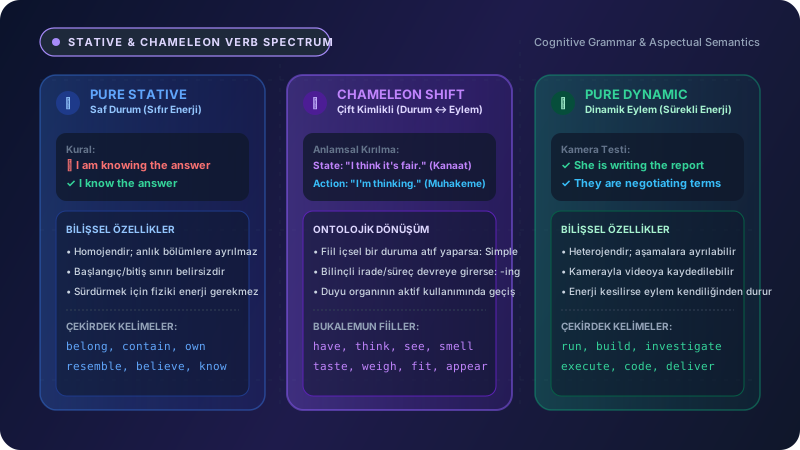
Why the Ironclad Classroom Rule Fails on Real Streets
Cast your mind back to your early English lessons. The teacher would divide the chalkboard into two rigid columns: on the left, Dynamic Verbs (run, eat, construct); on the right, underlined in stark red chalk, the untouchable Stative Verbs: know, believe, belong, love, have, see, smell... The admonition was categorical: "Never, under any circumstances, use these verbs in continuous tenses (-ing). Write that on a test, and you lose points."
Then life happened. You stepped into a boardroom in London or caught an Uber in Chicago, and you overheard a seasoned professional say over speakerphone:
"I'm actually seeing someone right now, but I'm thinking of relocating our engineering hub to Austin. Are you understanding where I'm coming from?"
Cognitive dissonance strikes immediately: "They just attached -ing to see, think, and understand in a single breath! Do native speakers not understand their own language?"
Far from it. They understand it so intuitively that they are deploying one of the most sophisticated instruments in Germanic and Romance linguistics: Aspectual Shift. It is time to abandon mechanical dogma and examine the genuine semantic mechanics at work.
The Cognitive Foundation: States versus Dynamic Processes
As linguist Bernard Comrie articulated in his landmark treatise Aspect, human cognition perceives external reality through two distinct ontological prisms:
1. Static States
Homogeneous across time. The inception, middle, and culmination share identical properties. Crucially: They demand zero energetic input to sustain.
"This vault contains classified documents."
The vault expends no calories or physical work to maintain custody of the files. The state simply endures.
2. Dynamic Processes
Heterogeneous across phases. They progress through stages over time. Crucially: The moment energy input ceases, the event terminates.
"She is negotiating with the institutional syndicate."
Negotiation requires continuous cognitive and verbal expenditure. Withdraw the energy, and the process dissolves.
Here lies the conceptual breakthrough: the English -ing suffix (Continuous Aspect) encodes that an event is unfolding dynamically through time, remains incomplete, and occupies a bounded temporal frame. When an underlying lexical item denotes an immutable ontological relationship (such as belong or resemble), appending -ing triggers a semantic short circuit. Knowing is not a sprint; it is an internal cognitive state.
A Practical Diagnostic Tool: "The Camera Test"
Whenever you are uncertain whether a verb functions statively or dynamically in context, apply this simple thought experiment:
"If I stepped into the room with a cinema-grade video camera, could I record this verb happening as physical motion on the viewfinder?"
- "She is drafting the quarterly earnings release." You can record fingers striking keys, paragraphs materializing on screens. (Dynamic = Continuous aspect is valid)
- "She owns 40% of the equity." Point the camera at her or the ledger. You cannot record "owning" as a physical act; you simply observe a human and a balance sheet. (State = Continuous aspect is barred)
The Real Magic: Chameleon Verbs and Semantic Bifurcation
The true genius of modern English is that certain verbs can fluidly alter their ontological identity depending on whether the speaker intends to denote a dormant state or an active cognitive expenditure:
| Verb | Stative Frame (Simple - No -ing) | Dynamic Process (Continuous - Valid -ing) |
|---|---|---|
| THINK | Settled Conviction / Opinion: "I think the valuation is realistic." | Active Mental Deliberation: "I am thinking through the tax implications right now." |
| HAVE | Possession / Relationship: "We have three subsidiaries in Zurich." | Experience / Consumption: "We are having dinner with our regulatory counsel." |
| SEE | Perception / Comprehension: "I see your rationale clearly." | Consultation / Dating: "She is seeing an executive coach twice a week." |
| TASTE | Inherent Property: "The vintage tastes remarkably balanced." | Deliberate Sensory Sampling: "The sommelier is tasting the second barrel." |
| APPEAR | Impression / Evidential: "The proposal appears economically sound." | Public Performance: "Counsel is appearing before the appellate court today." |
| WEIGH | Inherent Metric Mass: "The titanium chassis weighs 12 kilograms." | Action of Assessment: "The committee is weighing the relative geopolitical risks." |
Why Does McDonald's Proclaim "I'm Lovin' It"?
If conventional textbook grammar categorically excludes emotional statives like love from continuous forms, how has the most visible commercial tagline on Earth thrived for over two decades?
Because linguists recognize the phenomenon of Temporary Emotional Intensification. Stating "I love acoustic jazz" registers a durable, overarching personal preference. But putting on noise-canceling headphones and exclaiming "Oh man, I am loving this track!" conveys something fundamentally different: "Right now, in this heightened experiential slice of time, I am actively reveling in this sensation."
When a server approaches your table in San Francisco and asks, "Are you enjoying your evening?", they are not polling your permanent psychological disposition; they are interrogating the immediate, unfolding quality of your dining experience.
Three Legitimate Grammatical Havens for -ing with Stative Roots
Many second-language writers overcorrect and mistakenly strip -ing from structural positions where it is mandatory. Keep these three categories pristine:
- Nominal Gerunds as Subjects or Objects: "Knowing your counterparts' cognitive biases is an asymmetric advantage." (Here, -ing functions as a nominalizer, not an aspectual tense marker. It is impeccably correct.)
- Prepositional Complements: "She secured the promotion without compromising her professional ethics." (Prepositions in English strictly govern gerundive forms.)
- Progressive Gradation over Time: "I am understanding complex derivatives a little better every week." (Reflects ongoing developmental mastery in contemporary international English.)
Next time you evaluate whether a verb tolerates continuous aspect, refrain from memorizing brittle lists. Fire up the camera in your mind. Are you framing an immutable ontological posture, or are you narrating an energetic, bounded experience in motion? The answer will guide your syntax with unerring precision.
Download Vocabulary Guide For This Article
Download our custom-made printable PDF study sheet featuring all the essential vocabulary related to this topic.

Hakan Dağ
Founder & Language Architect
Software Engineer and English Instructor with 15+ years of experience in IT and education technology. Passionate about merging smart tools with genuine pedagogy.
Related Posts
Information Packaging and the End-Weight Principle: Why Your Grammatically Correct English Still Feels Clunky
Your grammar is spotless, your lexicon rich, your tenses immaculate—yet your English prose still feels heavy, awkward, and subtly alien to native ears. Exploring Michael Halliday and Randolph Quirk's Information Structure framework, we unravel the Golden Rhythm of English: the End-Weight Principle, syntactic clefting, and practical techniques to deprogram Turkish left-branching habits.
The Fine Line Between Perception and Intent: Sensory Verbs, Bare Infinitives, and the -ing Divide in English
If you memorized the difference between "I saw her cross the street" and "I saw her crossing the street" as just another grammatical rule, you are missing the profound cognitive architecture of perception in English. We unpack the boundaries between hear/listen, see/look/watch, and feel through Vendler's aspectual theory and Givón's functional syntax, revealing how bare infinitives vs. participles alter the mental camera angle.
The Tense Triangle: Five Tests That Structurally Separate Present Perfect from Past Simple
Have you ever heard the difference between "I have lost my keys" and "I lost my keys"? The first belongs in an exam, the second in a courtroom. Turkish has no perfect aspect, so this distinction has to be learned structurally rather than by ear. Here is the tense triangle, five diagnostic tests, and when past perfect is genuinely required.
💬 Discussion0
You must log in to comment.
Put Learning into Practice!
Improve your vocabulary with WordMaster, practice with an AI tutor.
Start for Free