Code-Switching: Getting Lost Between Two Languages is Not an Illness, It's a Superpower
Is mixing Turkish and English in mid-sentence a sign of decline or your brain's superpower?
Listen to Article (High-Definition Audio)
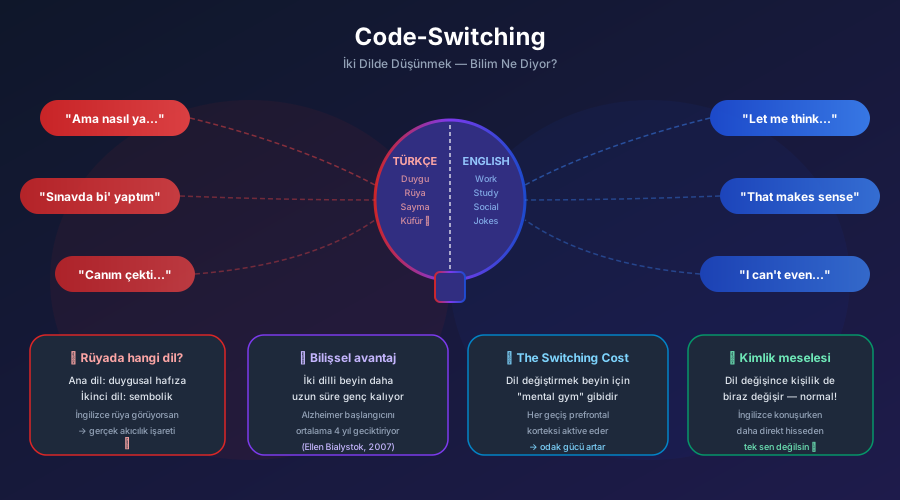
"Yesterday I went to a meeting, boss was very angry." You're code-switching! This isn't a disorder; it's your brain's superpower.
What is Code-Switching?
It's the phenomenon of switching between two or more languages within speech. For example:
"Today during brainstorming, a brilliant idea came to my mind but the manager didn't like it, we need to revise it."
You're not the only one doing this. Bilingual people all over the world do this. Americans mix Spanish and English (Spanglish), Indians mix Hindi and English (Hinglish), Germans mix Turkish and German. This is a universal bilingual experience.
Why Do We Code-Switch?
There are several scientific and psychological reasons:
1. Filling Word Gaps: Sometimes you recall a concept faster in another language. Especially in business terminology, English words feel more "ready": "deadline", "feedback", "brainstorming", "follow-up". When you think about Turkish equivalents, the English is already on your tongue. Your brain chooses the shortest path.
2. Emotional Expression: Some emotions are harder to express in your native language. Saying "I love you" might feel easier than saying it in your mother tongue. Because English might be coded in your brain as a language with lighter emotional load. Especially in shy situations, English creates a "safe zone".
3. Identity Marker: Code-switching sends the message "I belong to both cultures." You're both Turkish and an international professional. You can exist both in the neighborhood tea garden and in international meetings. This is a sign of belonging.
4. Group Belonging: Only your circle understands certain words. When you say "This project has a deadline," and the other person is in the same business world, you instantly connect. This is a kind of "one of us" code. It's even more pronounced in "start-up" culture: "pitch deck", "valuation", "exit strategy"...
5. Topic Change: Sometimes changing language when switching from one topic to another signals that transition. While speaking personally in Turkish, switching to English indicates you're moving to a professional topic.
Scientific Benefits of Code-Switching
Neuroscience research in the 2010s revealed that brains capable of switching between two languages perform 20% better in some areas than monolingual speakers.
1. Increased Cognitive Flexibility: Switching between languages develops the brain's "task-switching" capacity. In other words, you're faster when switching from one task to another. The prefrontal cortex becomes stronger through continuous language switching.
2. Better Problem Solving: Bilingual brains tend to look at problems from different angles. Because each language categorizes the world differently. Knowing a word like German "Schadenfreude" (pleasure from another's misfortune) gives you the power to better define that emotion.
3. Reduced Alzheimer's Risk: Research in Canada showed that Alzheimer's appears 4-5 years later on average in bilingual people. The brain "exercises" by constantly switching between two languages. This increases cognitive reserve.
4. Increased Creativity: Being able to combine different worlds of two languages triggers creative thinking. You're richer in word games, metaphors, and analogies. You can create new expressions by combining idioms from different languages.
5. Better Multitasking: Brains that code-switch are more successful at managing multiple tasks simultaneously. Because constantly tracking which language to use when is a form of multitasking training.
Code-Switching Examples from Around the World
Hinglish (Hindi + English): "Kal raat ko main party-ye ja raha hoon." (Last night I was going to the party.)
Spanglish (Spanish + English): "Voy a la store para comprar groceries." (I'm going to the store to buy groceries.)
Turklish (Turkish + English): "Weekend'de beach'e gidelim mi?" (Shall we go to the beach on the weekend?)
Konglish (Korean + English): "Na meeting haesseo." (I had a meeting.)
When Does Code-Switching Become a Problem?
Usually it doesn't. But there are exceptions:
1. Formal Writing: Code-switching is not done in formal texts like emails, reports, academic papers. In such cases, you need to use the standards of a single language.
2. Language Learners: If you're learning a language, code-switching can sometimes prevent you from gaining full fluency in that language. Especially at beginner level, it's better to fully learn both languages.
3. When the Other Party Doesn't Understand: If the person you're code-switching with doesn't know the same languages, this leads to communication breakdown. Consider your listener's language level.
Practical Advice
1. Don't Restrict Yourself: When code-switching, don't think you're speaking "bad Turkish" or "bad English." This is a natural process of your brain.
2. Recognize Context: Learn which language is more appropriate in which setting. Code-switching is acceptable in business meetings but not in formal exams.
3. Find Bilingual Friends: Spend time with people who code-switch like you. This helps you stay fluent in both languages.
4. Develop Both Languages: Code-switching comfort requires you to be strong in both languages. Read in Turkish, consume English content.
Conclusion
Code-switching is not an illness; it's a superpower! It's the ability to build bridges between two worlds. Remember: Language is for communication. If you communicate better by code-switching, don't hesitate to do it.
Next time you code-switch, don't feel guilty. Instead, think about how wonderfully your brain is working. You possess an ability that few people have: combining two languages to create a new form of communication.
And remember: Language is a living thing. It constantly changes, evolves, and takes new forms. Code-switching is part of this evolution. Embrace it!
Download Vocabulary Guide For This Article
Download our custom-made printable PDF study sheet featuring all the essential vocabulary related to this topic.
Osman Çoban
Lecturer in Education, University of Strathclyde
Lecturer in Primary Education at the University of Strathclyde. Holds a PhD in Education and an MA in Children's Literature from the University of Glasgow. Extensive experience in language education, ESL teaching, and professional translation across the UK.
Related Posts
The Subtle Diplomacy of Apology: Relationship Repair, Face-Saving, and Escaping the 'Sorry' Trap in English
Constantly saying 'Sorry' isn't polite—it's an unconscious reflex that erodes your executive presence. But how do you deliver a genuine apology when stakes are high? Unpack the 6-level severity continuum, Erving Goffman's face theory, formulas for defenseless accountability, and the transformative psychology of replacing 'Sorry for the delay' with 'Thank you for your patience'.
The Architecture of Politeness in English: Why "Could You" Always Outperforms "Can You"
English is not just a language — it's a social navigation system. Modals, pronouns, and indirect constructions encode hierarchy, distance, and intent. Navigate power, distance, and politeness through Brown & Levinson's Politeness Theory.
Cross-Cultural Pragmatic Traps: Where Directness Becomes Hostility in Global Tech
From pull request reviews to cross-border Slack standups: what happens when Dutch and German radical directness collides with Anglo-American diplomatic hedging? Master pragmatic calibration across Erin Meyer's Culture Map.
💬 Discussion0
You must log in to comment.
Put Learning into Practice!
Improve your vocabulary with WordMaster, practice with an AI tutor.
Start for Free