Why "That's Interesting" Can Be Dangerous: The Invisible Politeness Rules of British and American English
When a British person tells you "That's quite interesting," do you know what they actually mean? The answer might surprise you — and it goes far deeper than vocabulary differences.
Listen to Article (High-Definition Audio)
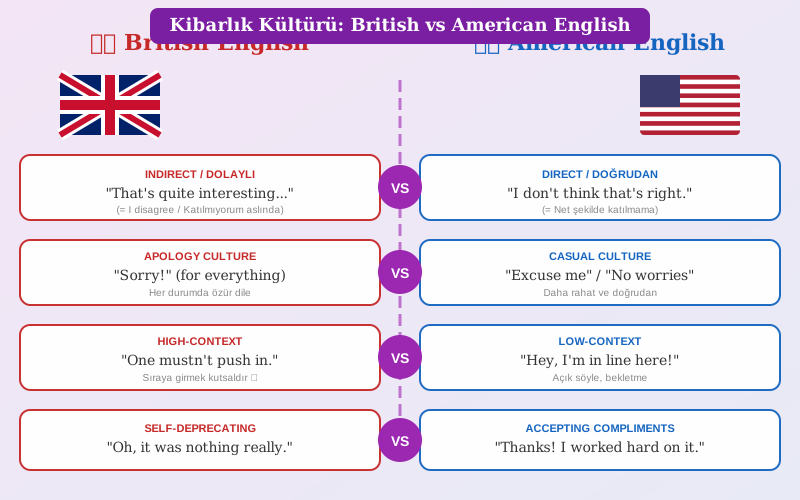
Here's something nobody tells you when you're learning English: British and American politeness work so differently that native speakers from each country regularly misread each other. The distance between what someone thinks and what they actually say varies enormously by culture — and without understanding that gap, you can't accurately interpret what you're hearing.
🇬🇧 British Politeness: The Art of Not Saying It
In British culture, direct criticism is almost nonexistent. In its place: carefully softened, layered expressions — and if you take them at face value, you'll misread situations constantly.
There's a famous "British English Translation Table" that circulates in diplomatic and expat circles. Here's how it works:
- "That's quite interesting." → Usually means: "That's not very interesting at all." or: I'd like to change the subject.
- "I hear what you're saying." → I've listened to you. But: I disagree with everything you just said.
- "With the greatest respect..." → Brace for a harsh critique. This phrase signals the exact opposite of respect.
- "That's a brave decision." → "That's a reckless one." Or at minimum: high risk, but clearly you've decided.
- "You might want to consider..." → You absolutely should do this. Not a suggestion — a politely packaged directive.
- "Not bad." → In British English, genuinely good. In American English, solidly average.
- "I'm sure it'll be fine." → The speaker is not sure at all. But they've said their piece.
- "Could we perhaps...?" → This is an instruction, not an invitation to debate. "Perhaps" just softens it.
Oxford research found that in British professional feedback settings, over 80% of critical feedback is delivered indirectly. So "I thought that went well overall" could easily mean "some things did not go well."
🇺🇸 American Politeness: Genuine or Performance?
Americans appear much more direct. "Great job!" "Awesome!" "I love this idea!" — these appear constantly in daily speech. But there's a surprise waiting for newcomers: these expressions are often social lubricant rather than genuine evaluation.
- "How are you?" — Not a real question. It's a greeting ritual. The expected answer is "Good, thanks!" Opening with "Actually, I've been struggling a bit..." tends to produce frozen expressions.
- "We should grab coffee sometime!" — May not be an actual invitation. Especially in professional settings, this often means: I like you, but there's no plan here.
- "That's an interesting perspective." — In America, this can genuinely mean interesting. In Britain, the same phrase signals skepticism. Context matters enormously.
- "Let's circle back on this." — I want to end this conversation now. Returning is not guaranteed.
- "I'll reach out." — Maybe I will. Maybe I won't.
🌍 Direct vs. Indirect: The Cultural Spectrum
Linguists map communication cultures along a spectrum:
- High-context cultures: Japan, China, Middle East, Britain. A lot of meaning lives in what's unsaid. Indirection is the norm.
- Low-context cultures: USA, Germany, Scandinavian countries, Netherlands. Direct, explicit, assuming that what you say is what you mean.
Turkey sits somewhere in between — high-context in family and social settings, more direct in professional and technical ones. This actually gives you a useful starting point for reading both systems.
⚠️ What to Actually Do
When communicating with British speakers:
- Soften direct criticism. Lead with "I was wondering if..." or "Would it be possible to...?"
- Be careful with "fine." "That's fine" in British English is sometimes not fine at all.
- Approach enthusiastic praise with mild scepticism, especially in professional settings.
- Learn "Could you possibly...?" — it works for virtually any request and sounds completely natural.
When communicating with American speakers:
- Don't be afraid to be direct. "I disagree" is a perfectly normal thing to say — people expect pushback.
- Keep "How are you?" answers short.
- Test genuine interest by proposing a concrete next step — "Let's schedule something for next week" will reveal whether they're actually interested.
- When you receive very positive feedback, look for the specific details — they'll tell you whether it's genuine.
📱 The Same Divide in Digital Communication
- British work email: "I hope this finds you well... I was wondering if it might be possible..." — very indirect opener.
- American work email: "Hi [name], Quick question..." or straight to the point.
- In British email, you can often read the tone from the length. An unusually short reply can actually signal irritation.
A British manager emails you: "I was just wondering if you'd had a chance to look at the report." It looks perfectly polite — but what it means is: "Why hasn't this been done yet?" Without knowing the code, you might read this as "no rush."
What to Take Away
Learning a language isn't just learning words and grammar — it's learning what a word means in a given context, in a given culture. And context is never culture-free.
If a British friend tells you "That's quite good," it's genuinely good. If a British manager says the same thing — think it over. Same words. Different worlds.
Download Vocabulary Guide For This Article
Download our custom-made printable PDF study sheet featuring all the essential vocabulary related to this topic.
Selin Aksoy
Bilingual Content & Culture Specialist
Curates cultural resources to help students immerse themselves in English. Expert in movies, literature, and real-world language usage.
Related Posts
The Subtle Diplomacy of Apology: Relationship Repair, Face-Saving, and Escaping the 'Sorry' Trap in English
Constantly saying 'Sorry' isn't polite—it's an unconscious reflex that erodes your executive presence. But how do you deliver a genuine apology when stakes are high? Unpack the 6-level severity continuum, Erving Goffman's face theory, formulas for defenseless accountability, and the transformative psychology of replacing 'Sorry for the delay' with 'Thank you for your patience'.
The Architecture of Politeness in English: Why "Could You" Always Outperforms "Can You"
English is not just a language — it's a social navigation system. Modals, pronouns, and indirect constructions encode hierarchy, distance, and intent. Navigate power, distance, and politeness through Brown & Levinson's Politeness Theory.
Cross-Cultural Pragmatic Traps: Where Directness Becomes Hostility in Global Tech
From pull request reviews to cross-border Slack standups: what happens when Dutch and German radical directness collides with Anglo-American diplomatic hedging? Master pragmatic calibration across Erin Meyer's Culture Map.
💬 Discussion0
You must log in to comment.
Put Learning into Practice!
Improve your vocabulary with WordMaster, practice with an AI tutor.
Start for Free